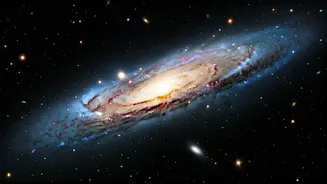

JWST's Time Machine
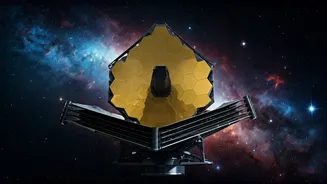
The James Webb Space Telescope (JWST) has made a spectacular discovery: the oldest known supernova ever observed. This remarkable finding showcases JWST's
unparalleled capabilities in peering into the distant past, allowing astronomers to witness events that occurred billions of years ago. The supernova, linked to the gamma-ray burst GRB 250314A, offers a unique opportunity to study the early universe. By analyzing the light from this ancient explosion, scientists gain valuable insights into the formation of stars, galaxies, and the overall evolution of the cosmos. The JWST's capacity to detect infrared light, which allows it to see through cosmic dust, is instrumental in uncovering these ancient events. This discovery not only pushes the boundaries of astronomical observation but also reinforces JWST's position as a leading instrument for unraveling the universe's mysteries.
Euclid's Galactic Gaze
Simultaneously, data from the Euclid mission reveals the powerful effects of galaxy mergers on supermassive black holes. These colossal structures, residing at the centers of most galaxies, can be triggered into intense activity by the gravitational forces of merging galaxies. Euclid's observations demonstrate that these galactic collisions are a catalyst for activating supermassive black holes, resulting in the emission of powerful jets and radiation. This phenomenon plays a crucial role in the evolution of galaxies, influencing their size, shape, and star-forming activity. By studying these interactions, researchers are developing a more complete understanding of how galaxies grow and evolve over cosmic timescales. Euclid's data, providing a comprehensive view of the universe, allows scientists to observe these events and assess their impact on the cosmic environment. This research strengthens the understanding of the deep interconnectedness in the cosmos.
Einstein's Prediction Verified
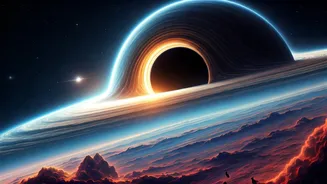
Further enhancing the scientific understanding, another discovery confirms a key prediction made by Albert Einstein over a century ago. Observations of a star's wobble around a black hole validate Einstein's theory of frame-dragging, a relativistic effect where the rotating black hole distorts the surrounding spacetime. This confirmation reinforces the accuracy of Einstein's general theory of relativity, which describes gravity as a curvature of spacetime. The precise measurement of this effect provides a deeper insight into the behavior of matter and energy in extreme gravitational environments. This validation is a significant milestone, strengthening our confidence in the fundamental laws that govern the universe. The precise measurements from the Webb telescope and other observational data are instrumental in the confirmation of this scientific principle, highlighting the importance of continual exploration and experimentation.