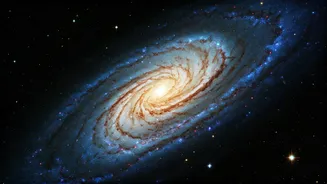

What is Dark Matter?
Dark matter, although unseen, plays a critical role in the universe's structure and behavior. Scientists can't directly observe it through telescopes,
as it doesn't emit or interact with light or other forms of electromagnetic radiation. However, they infer its existence through its gravitational effects on visible matter, such as galaxies and stars. This unseen substance is estimated to constitute roughly 85% of the total mass in the universe. It's the invisible scaffolding that shapes cosmic structures, influencing how galaxies rotate and how they cluster together. Despite its importance, the exact composition of dark matter remains unknown. It's not the same as the ordinary matter that makes up everything we can see, including atoms, protons, neutrons, and electrons. The search for dark matter particles is a major focus of modern astrophysics, with various experiments worldwide attempting to detect them directly or indirectly. The ongoing quest to understand dark matter is crucial for refining our understanding of the universe's evolution and fate.
Why It Matters
Dark matter's presence is essential for explaining several cosmological phenomena. One of the most significant pieces of evidence for dark matter comes from the way galaxies rotate. Observations show that stars at the edge of galaxies move at surprisingly high speeds, defying the laws of gravity based on the visible matter alone. This discrepancy can be explained if a large amount of unseen mass, dark matter, is present, providing the extra gravitational pull needed to keep these stars in orbit. Additionally, dark matter is crucial for explaining the large-scale structure of the universe. The way galaxies cluster together and form filaments, and voids observed in the cosmic microwave background (CMB), the afterglow of the Big Bang, also requires the presence of dark matter. Computer simulations demonstrate that without dark matter, the universe would have a significantly different structure. Understanding dark matter is also crucial for refining models of the universe's evolution, allowing scientists to comprehend how it expanded and how it will evolve in the future. Without the influence of dark matter, the universe as we know it would not exist, highlighting its critical role in the cosmos.
Unanswered Questions
Despite its importance, the nature of dark matter remains a profound mystery. Scientists don't know what it is made of, and there are several competing theories about the fundamental particles that make up dark matter. One of the most popular ideas is that dark matter consists of Weakly Interacting Massive Particles (WIMPs). WIMPs are hypothetical particles that interact through the weak nuclear force and gravity, but not electromagnetically, making them incredibly difficult to detect. Another possibility involves axions, ultra-light particles that could potentially explain dark matter. Furthermore, some scientists explore the possibility that dark matter is composed of primordial black holes, which formed in the early universe. Each of these theories comes with its own set of predictions, which scientists test through various experiments. Researchers are actively searching for dark matter through a variety of methods. These include direct detection experiments, which aim to observe dark matter particles interacting with ordinary matter, and indirect detection experiments, which search for the products of dark matter annihilation or decay. The quest to unveil the true nature of dark matter is one of the most exciting endeavors in modern astrophysics.
Future Discoveries
The hunt for dark matter continues with groundbreaking experiments. The James Webb Space Telescope (JWST) is poised to offer new insights by probing the far reaches of the universe. Scientists hope JWST can shed light on dark matter by studying distant galaxies and the distribution of matter. New research explores 'heavy' dark matter's potential impact on the universe, indicating it could potentially reshape existing understanding. The exploration of black holes from the universe's early stages may reveal clues about invisible matter's composition. Scientists are also using cutting-edge techniques to search for unusual signals that could indicate the presence of dark matter. Further, the detection of a 'dark object' within a warped Einstein ring, billions of light-years away, has fueled interest. In the future, these advanced observations and experiments may bring scientists closer to solving the mystery of dark matter and unraveling the unseen components of our universe. The ongoing efforts promise to refine our understanding of the cosmos.