






3D Atmospheric Mapping
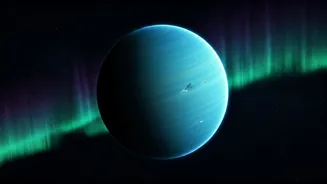
The James Webb Space Telescope has achieved a significant milestone by generating the first highly detailed three-dimensional representation of Uranus's
upper atmosphere. This intricate mapping allows scientists to observe the layering of the atmosphere from its lower reaches to its highest altitudes. By meticulously tracking fluctuations in temperature and the density of electrically charged particles as they vary with elevation, researchers have gained a much clearer understanding of the atmospheric conditions prevailing far above the planet's visible cloud tops. This innovative approach utilized the exceptional sensitivity of Webb's NIRSpec instrument, enabling continuous observation of Uranus for almost its entire rotational period. The data captured faint emissions from molecules in the upper atmosphere, which glowed brightly, providing crucial insights into the dynamics of energy circulation and balance within the outermost layers of ice giants.
Ionosphere and Magnetic Field
Led by Paola Tiranti of Northumbria University, the research delved into Uranus's ionosphere, a region extending up to 5,000 kilometers above the cloud deck where the atmosphere becomes ionized and intensely interacts with the planet's magnetic field. Measurements of both temperature and ion density within this zone have yielded the most comprehensive picture to date of where Uranus's auroras originate and how they are sculpted by the planet's notably oblique magnetic field. The findings corroborate earlier observations that Uranus's upper atmosphere has been experiencing a cooling trend over the past thirty years. Peak temperatures were identified at altitudes between 3,000 and 4,000 kilometers above the clouds, while the highest concentrations of ions were observed at approximately 1,000 kilometers. The study also highlighted distinct variations across different longitudes, directly attributable to the complex and asymmetrical structure of Uranus's magnetic field, offering a unique glimpse into the planet's intricate magnetospheric processes.
Long-Term Cooling Confirmed
Further analysis of the data collected by the Webb telescope confirms that Uranus's upper atmosphere continues to cool, a phenomenon first observed in the early 1990s. The research team calculated an average temperature in this region to be around 426 kelvins (approximately 150 degrees Celsius). This temperature is notably lower than figures previously recorded by ground-based observatories and earlier spacecraft missions, underscoring the sensitivity and precision of Webb's instruments. The ongoing cooling trend suggests a long-term energy imbalance or change in atmospheric processes on Uranus. Understanding this sustained cooling is critical for refining models of ice giant atmospheres and their evolution, contributing to a broader understanding of planetary climates beyond our solar system and the potential for similar phenomena on exoplanets.
Auroral Bands and Magnetosphere
Webb's observations revealed two prominent auroral bands situated close to Uranus's magnetic poles. Intriguingly, a noticeable decrease in both emission intensity and ion density was detected in the area situated between these two bright bands. Scientists believe this feature is closely linked to transitions in the magnetic field lines. Similar dark regions have been observed on Jupiter, where the planet's magnetic field configuration directs the flow of charged particles through its upper atmosphere. Uranus's magnetosphere is particularly unusual due to its significant tilt and offset from the planet's rotational axis. This orientation causes auroras to sweep across the planet's atmosphere in complex patterns. Webb's detailed vertical atmospheric data elucidates the deep reach of these magnetic effects, providing vital clues to the energy budget of ice giants and advancing our ability to characterize such planets throughout the cosmos.