







Meta's Silicon Strategy
In a significant move that places it among tech titans like Google and Microsoft, Meta has announced its own suite of four custom-designed AI chips. This
initiative is a direct response to the escalating costs and supply chain vulnerabilities associated with acquiring specialized hardware from third-party vendors such as Nvidia and AMD. By developing its own silicon, Meta aims to achieve greater command over its substantial data center expansion and AI processing capabilities. This strategic shift prioritizes an inference-first approach, meaning the chips are optimized for generating outputs from AI models, a crucial aspect for powering social media feeds and emerging generative AI applications. The company's commitment to internal chip development is underscored by its plan to iterate and improve these processors at an unprecedented pace, ensuring they remain at the forefront of technological advancement.
Rapid Iteration Pace
The cornerstone of Meta's new AI chip strategy is its ambitious plan to introduce updated versions of its Meta Training and Inference Accelerator (MTIA) chips every six months. This accelerated development cycle contrasts sharply with the typical one-to-two-year release cadence seen across the industry. This rapid iteration is made possible by Meta's adoption of modular and reusable design principles, allowing for swift integration of the latest hardware technologies and evolving AI techniques. The primary driver behind this speed is to maintain cost-effectiveness and agility in a rapidly changing technological landscape. By minimizing the time and expense involved in developing and deploying new chip generations, Meta can more readily adapt to the dynamic needs of AI processing and stay ahead of competitors.
Inference-First Optimization
Meta's MTIA chips are strategically designed with a focus on inference, a departure from the industry norm that often prioritizes large-scale generative AI pre-training. While mainstream chips are typically built for the most demanding training workloads and then adapted for inference, Meta is reversing this approach. The MTIA 450 and 500 models, for instance, are specifically optimized for generative AI inference, such as converting text prompts into detailed images and videos. This dedicated optimization ensures superior performance and cost-efficiency for inference tasks, which are projected to experience significant growth. These chips can subsequently be repurposed to support other workloads, including ranking and recommendation systems on platforms like Facebook and Instagram, as well as for certain AI training needs, making them versatile assets for Meta's diverse AI operations.
Existing & Future Chips
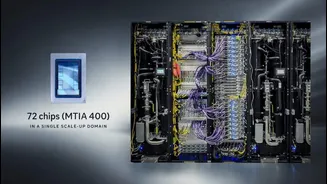
Meta's commitment to in-house AI silicon is already bearing fruit with the deployment of the MTIA 300 chip. This existing processor is currently handling critical "ranking and recommendation" tasks, playing a vital role in determining the content users see on Meta's popular platforms like Facebook and Instagram. Looking ahead, Meta is developing the MTIA 400, 450, and 500 series, which are engineered to tackle more complex generative AI applications. The company has confirmed that testing for the MTIA 400 is complete, and the remaining models are anticipated to become operational by 2027. This staggered rollout demonstrates a clear roadmap for enhancing Meta's AI capabilities across various demanding tasks, from content personalization to cutting-edge content creation.