






The Physical AI Frontier
Nvidia's chief executive, Jensen Huang, has articulated a forward-thinking perspective on the evolution of artificial intelligence, shifting the focus
from purely digital interfaces to tangible, real-world interactions. At a recent Adobe Summit, Huang elaborated on the concept of 'Physical AI,' a sophisticated technology designed to empower computers with a profound understanding of and ability to engage with the physical environment. He highlighted that while AI has made significant strides in processing digital information, the world's most impactful industries—spanning life sciences, manufacturing, logistics, and transportation—remain predominantly physical. For computing to effectively enhance and automate these sectors, it must first grasp the fundamental principles governing the physical world. Without this comprehension, the potential for AI to revolutionize these vast domains remains largely untapped, underscoring the critical need for AI to become adept at navigating and influencing our concrete surroundings.
The Necessity of Digital Twins
Huang emphasized that for many creators and manufacturers, precision is paramount; the products they design, their brand identity, and their aesthetic appeal all demand exacting standards, leaving no room for approximation. He posits that the foundational step towards achieving this level of accuracy in the physical realm is the creation of a perfect 'digital twin.' This digital representation must be a high-fidelity, entirely truthful, and precisely rendered 3D graphic replica of any given artifact, be it a vehicle, a cosmetic item, or even a human figure. This meticulously accurate digital counterpart serves as an indispensable bridge, enabling generative AI to then interact with and express creativity within the context of the real world. The starting point for this transformative process, he insists, is non-negotiable: a perfect digital twin.
Impact and Applications
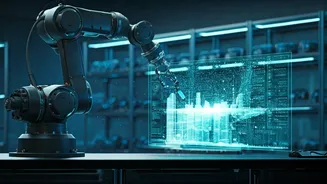
The strategic development of these exact 3D models, or digital twins, unlocks a multitude of powerful applications that significantly impact various industries. For manufacturing, it allows companies to conduct extensive and complex robot testing within a safe, virtual environment before deploying them onto factory floors, mitigating risks and optimizing performance. In logistics and transportation, these digital simulations enable the meticulous planning and testing of intricate systems, identifying potential efficiencies and resolving challenges without the costly and disruptive consequences of real-world experimentation. Furthermore, this approach harmonizes human creativity with artificial intelligence, using these precise digital artifacts as a dynamic canvas upon which entirely new designs and concepts can be envisioned and brought to life, pushing the boundaries of innovation.