
Sunspots and Activity
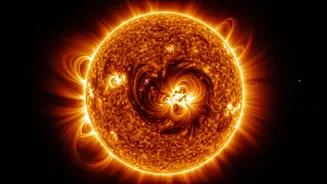
Sunspots, appearing as darker, cooler regions on the Sun's surface, are a key indicator of solar activity. These areas are characterized by intense magnetic
fields that can become unstable and trigger powerful solar flares and coronal mass ejections (CMEs). Scientists closely monitor sunspots because of their potential to disrupt technological systems on Earth and in space. A recent announcement indicated the presence of a massive sunspot complex, AR 4294, which could increase the likelihood of impactful solar storms. The size and complexity of these sunspot regions determine the potential strength of any resulting solar events, making their observation a critical part of space weather forecasting.
Solar Flare Impact
Solar flares are sudden bursts of energy released from the Sun's surface, often associated with sunspot activity. These events emit intense radiation, including X-rays and ultraviolet light, which can reach Earth within minutes. While the Earth's atmosphere and magnetic field provide some protection, particularly strong solar flares can disrupt satellite communications, GPS navigation systems, and power grids. The strongest solar flare in 2025 sent high-energy radiation rushing toward Earth. Depending on their intensity, solar flares can cause widespread technological disruptions, emphasizing the need for advanced warning systems and preparedness measures to lessen their impact.
Solar Storms and Risk
Solar storms are a broader category of space weather events, encompassing solar flares and CMEs. CMEs are massive expulsions of plasma and magnetic field from the Sun's corona. When these ejections reach Earth, they can cause geomagnetic storms, which can further disrupt technology. Geomagnetic storms can induce currents in power grids, leading to blackouts, and can also interfere with radio communications and damage satellites. Given the potential for significant disruption, scientists are continually working to improve their understanding of solar storms and their effects, using this knowledge to forecast and mitigate risks.
Forecasting and Mitigation
Predicting solar activity is crucial to protecting infrastructure. Scientists employ various methods, including monitoring sunspots, analyzing solar wind data, and using sophisticated computer models. Space weather forecasting provides advance warning of impending solar storms, enabling authorities to take precautionary measures. These actions might include rerouting air traffic, adjusting satellite operations, and preparing power grids for potential surges. Furthermore, research into space weather forecasting is ongoing, with the development of new technologies and modeling techniques. This pursuit helps create more accurate predictions and improves the ability to minimize the effects of solar events.
Long-Term Monitoring
Long-term monitoring plays a vital role in understanding the Sun's behavior. The Nancy Grace Roman Space Telescope, slated for launch between 2026 and 2027, will contribute significantly to space weather monitoring. By observing the Sun and its surrounding environment, the telescope will provide data on coronal mass ejections and other solar phenomena, aiding in better forecasts. Through constant monitoring and data collection, scientists can analyze solar cycles, improve predictive capabilities, and prepare for potential events. Long-term studies provide valuable data for understanding the relationship between the Sun and Earth's environment, enhancing preparedness for future solar storms.