




Powering the Future
NASA's Jet Propulsion Laboratory (JPL) has recently demonstrated a groundbreaking advancement in propulsion technology, marking a significant domestic
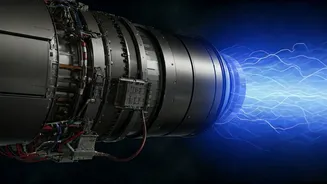
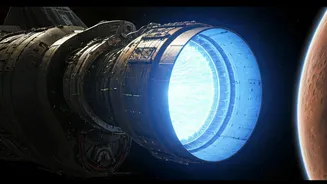
power output achievement of 120 kilowatts. This isn't your typical rocket engine; it's a sophisticated lithium-fed magnetoplasmadynamic (MPD) thruster. This innovative system employs powerful electromagnetic fields to accelerate ionized lithium gas, known as plasma, generating the immense thrust required for carrying substantial payloads into space. As NASA charts its ambitious course for missions from the Moon to Mars, this development is absolutely crucial for the successful implementation of nuclear-electric propulsion systems. It holds the potential to dramatically shorten interplanetary journey durations and considerably increase the amount of cargo that can be transported, thereby paving a more realistic path for human expeditions to the Martian surface.
Inside the Thruster
The core of this cutting-edge technology is a lithium-based magnetoplasmadynamic (MPD) thruster, recently subjected to rigorous testing. This system masterfully converts electrical energy into kinetic thrust by expelling ionized gas, or plasma, through a carefully controlled magnetic field. During these crucial experiments, the central tungsten electrode within the thruster reached temperatures exceeding 5,000 degrees Fahrenheit, a testament to the extreme conditions involved. This intense heat resulted in the generation of a remarkably swift and powerful plume of vaporized lithium. The efficiency of such a thruster is often measured by its specific impulse, a metric that essentially quantifies how effectively propellant is utilized – akin to optimizing mass-flow efficiency. This high level of efficiency makes the MPD thruster exceptionally well-suited to meet the demanding payload requirements of future crewed missions destined for Mars, ensuring that necessary supplies and equipment can be transported reliably.
Scaling for Mars
According to reports originating from NASA's Jet Propulsion Laboratory, the recent 120-kilowatt test represents a monumental stride forward. However, it's acknowledged that missions venturing to Mars will necessitate a significantly greater power output, potentially in the range of 2 to 4 megawatts. This JPL test unequivocally validates the feasibility of scaling up electromagnetic propulsion systems for more demanding applications. By utilizing lithium as its propellant, the engine experiences reduced wear and tear on its internal components, which substantially enhances its reliability for the extended durations characteristic of deep space voyages. This inherent robustness is a critical factor in ensuring the success of long-term crewed missions beyond Earth's orbit.
Nuclear Electric Propulsion
In its strategic planning for deep space exploration, NASA is actively investigating Nuclear Electric Propulsion (NEP) as the optimal power source for its electromagnetic thrusters, particularly in regions far from the sun where solar power is insufficient. Rather than relying on the diminishing energy of sunlight, an NEP system utilizes a compact nuclear reactor to provide a continuous and robust supply of electricity directly to the MPD thruster. This integrated approach is currently viewed as the most effective method for efficiently transporting substantial quantities of equipment, including vital life-support systems, to Mars, all while significantly minimizing propellant consumption. The synergy between a nuclear power source and an advanced plasma thruster offers a transformative solution for the challenges of interplanetary travel.