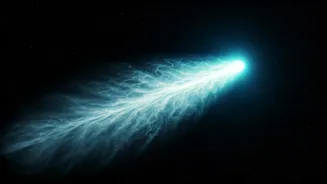

A Cosmic Wanderer
Comet 3I/ATLAS, an object from interstellar space, has been tracked as it journeyed through our solar system. Its unusual trajectory, originating from beyond
our sun, captured the attention of astronomers globally. This comet's arrival offered a rare chance to study an object that did not originate within our solar system, providing scientists with valuable information about the composition and characteristics of interstellar visitors. The comet's behavior, especially its unexpected brightening as it neared the sun, intrigued researchers, adding to the intrigue of this cosmic traveler. The ESA confirmed the comet's safe passage, highlighting the event's scientific significance.
Unexpected Brightening Observed
As comet 3I/ATLAS approached the sun, it exhibited a peculiar behavior: an unexpected brightening. This phenomenon, observed by observatories across the globe, puzzled scientists. The comet's increased luminosity, exceeding initial predictions, prompted intense scrutiny and detailed analysis. This unexpected brightening hinted at complex processes occurring within the comet's structure, possibly related to the vaporization of its icy components or the release of dust particles. The heightened brightness provided researchers with a closer look at the comet's dynamic nature and its response to solar radiation. Scientists worldwide were eager to interpret the cause of this unusual observation, anticipating valuable information about the object.
Jet Activity and Wobbling
New images of comet 3I/ATLAS revealed the presence of a giant jet extending toward the sun, a surprising observation. Moreover, the comet's jets exhibited a wobbling motion, adding another layer of complexity. These observations suggested that the comet's surface was highly dynamic, with active processes driving the ejection of gas and dust. The wobbling jets indicated the comet's internal structure or its interaction with solar radiation were likely highly variable. Such activity is usually observed in comets, and provides insight into the composition and behavior of interstellar visitors. The unusual jet characteristics offered a unique opportunity to study these properties in unprecedented detail. This data helped scientists to understand the underlying mechanisms that govern the activity of these interstellar travelers.
Closest Earth Approach
The comet made its closest approach to Earth on December 19th, offering a unique opportunity for in-depth observations. This close flyby allowed scientists to use an array of advanced instruments to analyze the comet's composition, structure, and behavior. Skywatchers had a chance to view it. The proximity of 3I/ATLAS allowed for more precise measurements, detailed imaging, and improved data collection. This event provided scientists with an unparalleled view of an interstellar object. The rare alignment of the comet and Earth offered a unique scientific window, fostering collaborations and yielding valuable insights into the secrets of interstellar space. The timing and path of the comet, offered a significant opportunity.
Global Observation Efforts
Astronomers and observatories across the globe collaborated to track and study the interstellar comet 3I/ATLAS. These efforts involved utilizing a variety of telescopes, both ground-based and space-based, to observe the comet's path and monitor its properties. Scientists gathered an array of data, including images, spectra, and measurements of its brightness and gas emissions. These collaborative observations have been essential for understanding the comet. The collection of data allowed scientists to analyze the comet's dynamics, revealing valuable information. The collaborative work showcased the global scientific community and fostered a deeper understanding of the comet's unique properties.
Insights and Future Studies
The close approach of comet 3I/ATLAS generated a wealth of information about interstellar objects. Scientists are still analyzing the data to unlock the secrets held within the comet's structure and activity. This event has provided researchers with a deeper understanding of the composition, behavior, and the origin of these cosmic visitors. The data collected during this event will likely shape future studies of interstellar objects. Scientists are planning follow-up research. This event has highlighted the importance of continued exploration and data analysis. These analyses will contribute to our understanding of the broader cosmos.