





Sandy Surprise at Antofagasta
In April 2026, NASA's intrepid Curiosity rover arrived at a 10-meter wide crater designated Antofagasta, anticipating a prime opportunity to collect rock
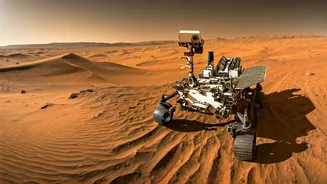
samples. However, upon its arrival, the mission team was met with an unexpected sight: the crater floor was completely blanketed in dark, rippled sand, likely deposited by Martian winds. This sandy inundation presented a significant problem, as the scientists had originally selected Antofagasta precisely because its exposed layers promised valuable insights into Mars' geological past. The sand now concealed these crucial formations, making direct drilling impossible without risking the rover becoming trapped in the loose material. The team quickly reassessed the situation, recognizing that their initial drilling objective at this location could not be met. Their immediate priority shifted from sampling the buried layers to understanding the new environmental conditions and finding an alternative approach to their scientific investigation on the Martian surface.
Adapting the Exploration Strategy
Faced with the impracticality of drilling into the sandy expanse of Antofagasta, the Curiosity mission scientists had to devise an alternative plan. Driving directly into the sand dunes was deemed far too perilous, with a high probability of the rover becoming irretrievably stuck. The team also conducted a thorough examination of the surrounding rocks, searching for any potential crater ejecta that might offer alternative sampling opportunities. Unfortunately, these nearby rocks did not present any clear targets that could substitute for the planned analysis. Consequently, Curiosity did not perform any drilling operations within Antofagasta. Instead, the rover utilized its sophisticated camera systems and scientific instruments to meticulously study the exposed rock formations along the crater's rim. This observational approach allowed the team to gather valuable data about the surrounding geology and the effects of Martian weathering, even without direct sample acquisition from the crater floor.
New Drilling Site Identified
Looking ahead, the Curiosity mission is strategically shifting its focus to a different area for future drilling activities. The mission scientists have identified a promising new sampling site situated higher up on a geological feature known as the 'boxwork' area. This region is characterized by sulfate-bearing strata, which are of particular interest for understanding Mars' water history and geological evolution. On Sol 4870, the rover pinpointed a 'drillable' rock formation within this 'boxwork' area, which has been officially named 'Atacama' by the team. The scientific investigation at Atacama will involve a series of rigorous steps. First, the rover will employ its analytical tools to assess the rock's composition and suitability for drilling. If the preliminary analysis proves favorable, a 'preload' test will be conducted to ensure the rock can withstand the drilling process. Following a successful preload test, Curiosity will then extract a core sample from this new sulfate-bearing bedrock. The analysis of this sample is anticipated to provide crucial information that will significantly enhance our understanding of Mars' ancient geological history and support ongoing efforts for future Mars exploration.