






Mars Gravity Assist Maneuver
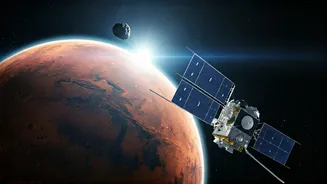
The Psyche spacecraft recently executed a critical gravitational assist maneuver by closely passing Mars. This technique, a staple in space exploration,
leverages a planet's gravitational pull to alter a spacecraft's velocity and trajectory without expending precious onboard fuel. By navigating within Mars' gravitational field, Psyche effectively 'borrowed' energy from the planet, accelerating its journey and fine-tuning its path toward its ultimate destination. This sophisticated dance with a celestial body is a testament to the ingenuity of mission planners, ensuring the spacecraft reaches its target efficiently and conserves its limited propellant for later stages of the mission. The close flyby, occurring just 2,864 miles above the Martian surface, provided the necessary impetus for the spacecraft's long voyage to the asteroid belt.
Journey to Asteroid Psyche
The primary objective of the Psyche mission is to investigate the asteroid of the same name, a celestial body thought to be the exposed nickel-iron core of a protoplanet. Scientists believe that by studying Psyche, we can gain unprecedented insights into the formation processes of rocky planets, including the very core of our own Earth. Launched in October 2023, the spacecraft is now on a direct trajectory toward this enigmatic target, with an estimated arrival date in the summer of 2029. The success of the Mars gravity assist has put Psyche firmly on course, allowing mission engineers to monitor its progress with confidence through the Deep Space Network. This journey represents a significant step in understanding the building blocks of our solar system.
Unusual Mars Imagery
During its close encounter with Mars, the Psyche spacecraft also served as an observational platform, capturing unique views of the Red Planet. Due to the spacecraft's approach trajectory, Mars presented a rare crescent phase, illuminated by sunlight scattering through its atmosphere, creating an unexpected visual effect. The mission's multispectral imager collected thousands of images, providing scientists with valuable data for calibrating the instrument and refining image processing techniques for asteroid observations. These images, along with data from other scientific instruments like magnetometers and spectrometers, were tested and verified during the flyby, ensuring they are ready for operation at the asteroid. This dual purpose of the flyby—both a navigational necessity and a scientific opportunity—underscores the mission's meticulous planning.
Instrument Calibration and Testing
Beyond its navigational role, the Mars flyby was an instrumental testing ground for Psyche's scientific payload. The spacecraft activated its cameras, magnetometers, and gamma-ray and neutron spectrometer, gathering crucial calibration data. Initial readings from the magnetometers potentially detected Mars' bow shock, a key indicator of its interaction with the solar wind. Simultaneously, the spectrometer team collected early measurements to compare with extensive historical data from Mars. This comprehensive testing phase ensures that all instruments are functioning optimally and ready to conduct their detailed survey of the asteroid Psyche upon arrival. The successful validation of these instruments is vital for the mission's scientific success in unraveling the mysteries of the asteroid.