







The Lithium Challenge
Lithium-ion batteries are widely used because they're efficient, but they come with potential safety hazards. One major issue is the risk of thermal runaway,
which can lead to fires or explosions. These incidents are often caused by the formation of dendrites, tiny lithium structures that grow and cause short circuits within the battery. The challenge is to find ways to make lithium-based batteries safer and to increase their capacity. This involves modifying the design or the materials used to prevent the development of these dendrites, thereby stabilizing the battery's performance and significantly reducing risks.
Magnetic Control Explained
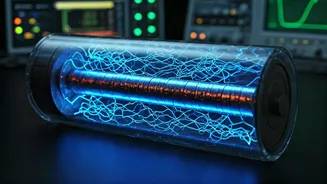
The innovation relies on using magnetic fields to control the behavior of lithium within the battery. By applying magnetic forces, scientists can affect how lithium ions move and deposit, which can prevent the formation of the problematic dendrites. This approach changes the internal dynamics, providing a safer environment for energy storage. The core idea is to guide the lithium deposition process with precision, ensuring that the lithium layer remains uniform and free from the structural weaknesses that lead to short circuits. This results in batteries that are not only safer but also can potentially hold more energy without the usual risks.
Enhanced Capacity Potential
Alongside improved safety, magnetic control could also boost the energy density of batteries. This means that these batteries could store more energy per unit of volume or weight. This improvement comes from the ability to use lithium more efficiently without the limitations imposed by safety concerns. Increased energy density is very important because it enables a range of benefits, from extending the range of electric vehicles to making portable electronic devices last longer. The ability to increase both capacity and safety represents a significant leap forward, setting the stage for the next generation of power storage.
Real-World Applications
The implications of this breakthrough are extensive, touching many industries. Electric vehicles (EVs) are a prime area for this technology. Safer, higher-capacity batteries can significantly extend driving ranges and reduce charging times, making EVs more practical. Consumer electronics such as smartphones and laptops would benefit from longer battery life. Besides these, the innovation could also revolutionize energy storage systems. This would make renewable energy sources more viable and resilient. The technology could also be applied in grid-scale energy storage solutions, supporting more sustainable and efficient energy networks.
Future Research Directions
Researchers aim to further refine magnetic control methods to enhance battery performance. This includes optimizing the magnetic field strength and configurations for maximum effect. Another area is scaling up the technology for mass production, reducing manufacturing costs, and improving the durability of the batteries. Ongoing research will also focus on integrating these batteries with other emerging technologies, such as solid-state electrolytes. Collaboration between scientists, engineers, and manufacturers is essential for turning this dream battery into a commercial reality. The goal is to move beyond lab experiments to large-scale deployment to meet the growing need for safe and effective energy storage solutions.