





Fomalhaut System Collisions
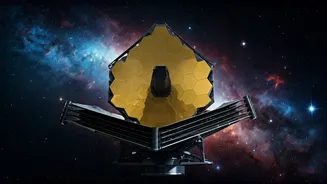
Hubble has provided remarkable views of the Fomalhaut system, a stellar arrangement that has been the focus of intense scrutiny. The telescope witnessed
two instances of rare planetesimal collisions. These collisions, like celestial car crashes, reveal the raw process of planet formation. Imagine huge rocky bodies smashing into each other at astronomical speeds, creating clouds of debris that eventually coalesce to form new planets. These events, observed through Hubble’s advanced instrumentation, offer a unique perspective on the dynamic nature of planetary systems beyond our own. The dust clouds from these collisions are so massive that, at times, they might even trick astronomers into thinking they've found planets. The violence in space that Hubble revealed near Fomalhaut helps scientists understand the challenges and triumphs of planetary development.
Betelgeuse's Stellar Eruption
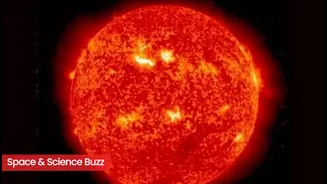
Hubble's observations extend beyond collisions, offering a glimpse into the life cycle of massive stars. One noteworthy instance is the study of EK Draconis, where a major stellar eruption was captured. The eruption, an event of immense scale, provides clues about conditions that may have fostered the emergence of life. This research also included the study of the red supergiant star Betelgeuse. The study revealed, for the first time, a companion star orbiting the supergiant. This orbit provides fresh insights into how such giant stars interact within their environment. It highlights the volatile nature of stellar life and its connection to planetary systems. The red supergiant Betelgeuse's companion also contributes a great deal to understanding its evolution.
NGC 4388's Gas Escape
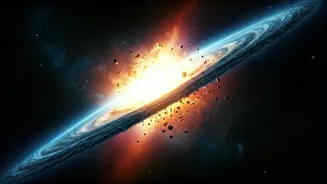
Hubble also offered a look at the galaxy NGC 4388, observing gas escaping sideways. This offered a unique look at galactic evolution and the interactions within the Virgo Cluster. These observations provide a detailed snapshot of the intricate processes that shape galaxies. It provides essential data that helps refine models of galactic dynamics. Hubble’s capacity to capture these events offers a crucial perspective that complements the telescope's work in stellar events. The work is crucial for understanding how galaxies and planetary systems are affected by external events and internal processes. Such observations underline the ongoing complexity and the dynamic nature of the cosmos.
Planet Formation Insights
The combined data from these Hubble observations yields a better grasp of planet formation. The data indicates that planet formation is not a smooth, gradual process, but rather a violent, dynamic one. The collisions and eruptions seen reveal that planetary systems go through phases of dramatic change. Hubble's work has also highlighted that the environment of a star plays an important role in the way planets form. The telescope's ability to view and record such dramatic changes contributes to our knowledge. These findings provide information that supports theoretical models. They also guide the planning for future research. This constant evolution of the universe is a crucial element that scientists are working to understand.