





The AI Cyber Threat
Artificial intelligence is transforming the landscape of cyber warfare, offering attackers capabilities that evolve and adapt in real-time. Unlike traditional
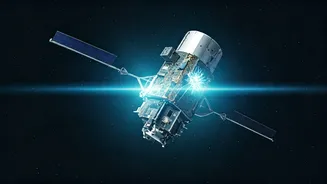
threats, AI can autonomously identify system vulnerabilities and devise intricate attack plans with minimal human oversight. This dynamic nature makes AI-powered cyberattacks particularly concerning for space systems, which are increasingly digital and interconnected, as highlighted by the European Space Agency. Satellites, the vital conduits for communication, navigation, and weather data, are prime targets. Their software can be compromised, and AI can be harnessed to exploit these weaknesses on a massive scale, posing a significant danger to the global satellite network.
Satellite Apocalypse Scenarios
The concept of a 'satellite apocalypse' might sound alarmist, but the potential ramifications are profoundly serious. A successful cyberattack could lead to critical failures, such as the disruption of commands sent to satellites, the complete breakdown of communication links, or even intentional manipulation causing in-space collisions. These failures would have widespread impacts on daily life, as space systems are fundamental to essential services like navigation for aircraft, secure financial transactions, and the operation of emergency services. In the most dire outcome, a cascade of collisions could occur, a phenomenon known as the Kessler Syndrome, rendering large sections of Earth's orbit unusable and jeopardizing future space exploration and utilization.
Inherent System Vulnerabilities
Many satellites currently in orbit are legacy systems, designed long before the advent of sophisticated AI-driven cyber threats. Consequently, they often lack fundamental security features like robust encryption, secure authentication protocols, and the ability to receive crucial software updates. Historical design considerations, as noted in research from IEEE Communications Surveys & Tutorials, gave limited thought to cybersecurity. The rapid advancement of AI amplifies these pre-existing weaknesses, as AI algorithms can swiftly scan and pinpoint exploitable entry points. The growing proliferation of private satellite constellations further complicates the challenge of maintaining comprehensive security across the entire space domain.
Preparedness and The Path
While efforts are underway to bolster space system security, many experts believe current measures are insufficient to counter the scale of the AI-driven threat. Major space agencies like NASA and ESA, alongside private entities such as SpaceX, are investing in more resilient systems and AI-powered defenses. The U.S. National Institute of Standards and Technology (NIST) emphasizes building resilience by assuming systems will be compromised and designing for rapid recovery. However, the international nature of space creates a coordination challenge, with varying cybersecurity standards across nations and organizations. Even highly secure individual systems can be jeopardized by vulnerabilities in interconnected components, underscoring the need for unified global security strategies.