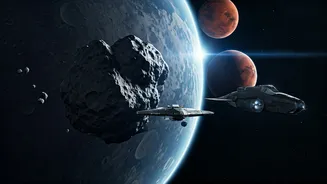






Stepping Stones to Mars
The long durations of traditional Mars missions, often spanning six to nine months due to limited fuel and orbital mechanics, are a significant hurdle.
However, a groundbreaking concept suggests utilizing certain Near-Earth asteroids as celestial waypoints. By strategically positioning spacecraft to interact with these asteroids, astronauts can harness the power of 'gravitational assists.' This maneuver allows a spacecraft to alter its speed and direction by drawing on the asteroid's gravity, a technique that provides a substantial velocity boost without consuming any precious onboard propellant. This integration of astrophysics and space engineering opens a new paradigm for efficient and economical space travel.
Asteroid Resources Unleashed
Beyond acting as mere gravitational aids, asteroids themselves present an incredible opportunity for in-space resource utilization (ISRU). Many asteroids are believed to contain significant deposits of water ice. This ice can be efficiently separated into hydrogen and oxygen, the fundamental components needed for rocket propellant. The ability to source life support and fuel locally, rather than launching everything from Earth, dramatically reduces mission mass and cost. Establishing refueling depots or resource extraction points at or near these asteroids could dramatically shorten transit times to Mars, making rapid journeys a tangible reality.
Advanced Propulsion Synergy
The potential for asteroids to enhance advanced propulsion systems is another exciting facet of this revolution. While ion engines offer superior fuel efficiency compared to conventional chemical rockets, they typically possess lower thrust. By coupling ion engines with asteroid-based fuel sources or gravitational assists, their effectiveness can be significantly amplified. Furthermore, technologies like nuclear thermal propulsion, which has the potential to halve the trip to Mars, could achieve even more remarkable results when integrated with asteroid-derived fuel or gravity-assist maneuvers. NASA reports indicate that nuclear thermal propulsion alone could reduce transit times to as little as three to four months, a significant leap forward.
Future of Interplanetary Travel
While still in its early stages, the application of asteroid science to space mission planning heralds a transformative shift in how we approach interplanetary travel. Viewing asteroids not just as celestial bodies but as valuable resources unlocks the possibility of frequent and rapid missions to Mars. This paradigm shift could not only empower astronauts in their scientific endeavors but also pave the way for sustained human presence and eventual colonization of the Red Planet. Ultimately, asteroids may prove to be the key enabler for making Mars exploration swift and accessible enough for humanity to embark on its quest for life beyond Earth.