
Hubble’s Cosmic View
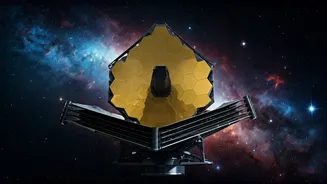
The Hubble Space Telescope, a collaboration between NASA and the European Space Agency, has been instrumental in observing the universe for over three
decades. Its high-resolution capabilities allow astronomers to peer into distant galaxies, study the atmospheres of exoplanets, and witness events such as the collision of celestial bodies. The recent observations provided by the Hubble telescope involve a nearby planetary system. This system is undergoing a period of intense planet formation. These observations offer a rare window into the early stages of a planetary system's life, helping astronomers understand how planets are formed and how they interact with each other. The data collected from such events contribute to a better understanding of our own solar system's origins and the potential for life elsewhere in the universe.
Violent Planet Building
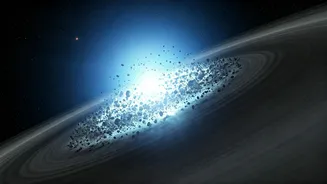
The collision observed by Hubble involved a protoplanetary disk, a swirling cloud of gas and dust surrounding a young star, where planets are actively forming. The event revealed the violent nature of planet formation. Within this disk, rocky materials collide and stick together. These collisions cause planets to grow larger. Occasionally, these collisions are incredibly energetic. They can result in fragmentation of the colliding bodies. Astronomers have gained insights into the processes, including the timescales and the composition of the materials involved in forming planets. Studying these collisions can help determine the frequency of such events in different planetary systems and their influence on planetary evolution. These insights contribute to a broader understanding of the diversity of planetary systems and the conditions under which planets can potentially support life.
Spacetime Twisting Observed
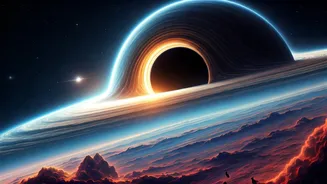
The observation of a black hole twisting spacetime confirms Einstein’s theory. This theory, proposed over a century ago, describes gravity not as a force, but as a curvature of spacetime caused by mass and energy. The recent observations provide compelling evidence. They allow scientists to probe the extreme gravitational effects near black holes. The data gathered provides further validation for general relativity, which is fundamental to our understanding of the universe. The study of black holes and their interaction with surrounding spacetime is also crucial in refining cosmological models and exploring the nature of dark matter and dark energy. Black holes, with their immense gravitational pull, have always been one of the biggest mysteries in the universe.
Ongoing NASA Mission
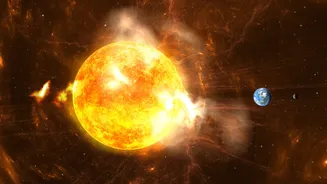
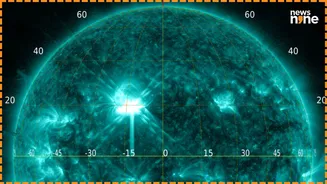
NASA's PUNCH mission is providing continuous views of solar eruptions across space. The mission aims to observe the Sun's outer atmosphere, called the corona, and the solar wind, the stream of charged particles that flows outward from the Sun. These eruptions, or solar flares and coronal mass ejections (CMEs), can have significant impacts on Earth. PUNCH’s observations allow scientists to track these events in real-time, helping to improve space weather forecasting. This data also contributes to a deeper understanding of the processes that drive these eruptions and their effects on the interplanetary environment. By studying these events, scientists can better prepare for and mitigate the effects of space weather events on Earth and in the region of space. The PUNCH mission is expected to deliver valuable data for years to come, offering a more complete picture of our Sun and its influence.