





Spacetime's Twist Revealed
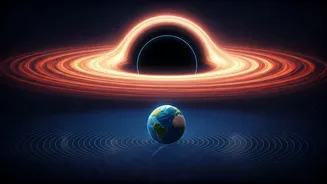
The remarkable observation of a black hole contorting spacetime marks a significant advancement in astrophysics. This discovery provides direct evidence
supporting Einstein’s theory of general relativity, which predicts that massive objects warp the fabric of spacetime. The research team meticulously analyzed data to witness this effect, offering a visual confirmation of what was previously only theoretical. Through sophisticated observational techniques, scientists were able to detect the gravitational influence of the black hole, demonstrating its ability to twist and distort the space and time around it. This confirms a fundamental concept about how gravity operates within the universe, further solidifying the cornerstone of our cosmological models and the framework used for our comprehension of how the cosmos operates. The finding underscores the continued relevance of Einstein’s predictions, made over a century ago.
Einstein's Theory Verified
The observations directly validate Einstein’s theory of general relativity, a cornerstone of modern physics that describes gravity not as a force but as a consequence of spacetime curvature. The warping of spacetime around massive objects, such as black holes, is a key prediction of this theory. The ability to observe this phenomenon offers strong empirical support for the theoretical framework Einstein developed. The confirmation provided by these observations reaffirms the accuracy and wide-reaching implications of general relativity. The research further enhances our belief in Einstein’s concept of how gravity shapes the universe, and it offers an opportunity to further develop models that take into account the behavior of gravitational forces, especially those surrounding incredibly massive objects. The findings represent a pivotal moment, strengthening our existing ideas regarding the makeup of the universe and its ongoing dynamics.
Observational Techniques Used
The ability to observe the effects of a black hole twisting spacetime hinged on the application of cutting-edge observational methods and technologies. Scientists deployed advanced telescopes and data analysis techniques to analyze the light emanating from the black hole's environment. The techniques involved detailed examination of the light spectrum, its intensity, and its polarization. These intricate analyses allowed the researchers to detect subtle shifts in the light paths and patterns. This, in turn, allowed them to determine the level of spacetime distortion around the black hole. The success underscores the critical role of technological innovation in furthering our understanding of the universe. This recent accomplishment highlights the combined efforts of technological innovation, advanced data analytics, and the diligent work of scientists. This collaborative effort helps deepen our grasp of astronomical phenomena.
Implications for Cosmology
This discovery holds significant implications for cosmological models and our understanding of the universe's evolution. It reinforces the accuracy of general relativity in extreme environments, enhancing our ability to model and interpret the behavior of galaxies and other celestial objects. The ability to validate Einstein's theory near a black hole adds another layer of scientific understanding, and it will also allow for better interpretations of phenomena such as gravitational waves. By confirming the theory’s accuracy in such a high-gravity context, astronomers are equipped with refined instruments and understanding. That is important for improving cosmological models. The ongoing verification of general relativity is crucial for refining our understanding of the universe. These insights have the potential to reveal more about the cosmos.
Future Research Avenues
The recent findings open up new avenues for future research in astrophysics. The confirmation of spacetime distortion around black holes encourages further investigation into the dynamics of these objects, including their role in galaxy formation and the emission of high-energy particles. Future research could investigate the behavior of other celestial objects, and it might also concentrate on improving measurement accuracy. Also, future research could explore the effects of gravity in extreme environments. Scientists may seek to develop improved models and simulation methods. The results will continue to stimulate creativity in the field. These ongoing investigations will lead to a deeper understanding of black holes and the universe as a whole.