






Unlocking Toxin's Secret
For nearly two decades, the scientific community has been trying to understand the precise way the bacterium Bacteroides fragilis inflicts damage on the colon,
a process linked to colorectal cancer. While it was known that this common gut inhabitant releases a toxin, BFT, which can lead to colon cell deterioration, the exact mechanism of its attachment to host cells remained elusive. Now, a dedicated research effort, spearheaded by scientists at Johns Hopkins, has successfully identified this crucial missing link. Their groundbreaking findings, published in the esteemed journal Nature, pinpoint claudin-4, a specific host receptor, as the essential docking site for the B. fragilis toxin before it can exert its damaging effects. This revelation is a significant leap forward, offering profound insights into the intricate interplay between gut microbes and human health, and opening doors for novel therapeutic interventions against associated diseases like diarrhea, colon cancer, and even systemic infections.
Claudin-4: The Missing Piece
The journey to identify the claudin-4 receptor was a meticulous process, driven by the need to understand how the B. fragilis toxin (BFT) operates. Previous research had established that BFT disrupts E-cadherin, a vital protein responsible for maintaining the integrity of the colon's protective barrier, thereby fueling chronic gut inflammation and contributing to tumor formation. However, it was observed that BFT didn't directly bind to E-cadherin, suggesting an intermediary step was at play. To uncover this, researchers employed a large-scale CRISPR screen, systematically deactivating genes in colon epithelial cells. This comprehensive screening method, led by Maxwell White, an M.D./Ph.D. candidate in the Cynthia Sears lab, in collaboration with Harvard Medical School, revealed claudin-4 as the critical factor. When claudin-4 was absent or inactivated, the BFT toxin was unable to attach to the colon cells, leaving E-cadherin untouched and the cell barrier intact. This discovery was a pivotal moment, confirming a long-suspected but unproven pathway in the toxin's mechanism of action.
Surprising Binding Mechanism
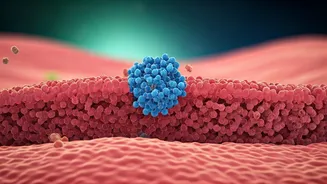
The identification of claudin-4 as the receptor for the B. fragilis toxin (BFT) came as a considerable surprise to many researchers. The prevailing expectation was that such toxins would interact with signaling proteins, like G-protein coupled receptors, which are common targets for many biological agents. However, claudin-4 is not a signaling protein; it plays a role in cell adhesion. This unconventional binding mechanism prompted the team to delve deeper. Through extensive literature review, they found no other known toxins that operate in a similar fashion, requiring a separate receptor before attacking their primary target. To solidify their findings, the Johns Hopkins team collaborated with structural biologists at the Molecular Biology Institute of Barcelona. Using sophisticated biophysical analysis, they demonstrated a robust one-to-one complex formation between BFT and claudin-4 in a controlled laboratory setting. This provided the first definitive evidence of their direct physical interaction, confirming the unexpected nature of the toxin's engagement with host cells.
Decoy Strategy's Success
Armed with the knowledge that claudin-4 is the gateway for the B. fragilis toxin (BFT) to damage colon cells, researchers explored a novel therapeutic strategy. They engineered a 'decoy' protein, essentially a soluble version of claudin-4, designed to mimic the natural receptor. The hypothesis was that BFT would preferentially bind to these decoy molecules rather than the actual claudin-4 present on the colon lining. To test this, the decoy protein was introduced into mouse models. The results were highly encouraging: the BFT toxin readily attached to the decoy proteins, effectively preventing it from reaching and damaging the colon cells. This meant that the mice were protected from the toxin-induced harm. This experimental success suggests a promising avenue for developing preventative measures against the adverse effects of B. fragilis, potentially through small molecules or other biological agents that can effectively intercept the toxin before it initiates damage. The team is now focused on refining these molecular approaches.