






Defining the Blimp
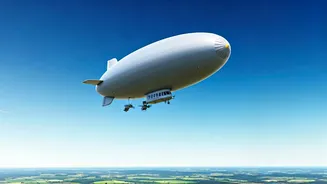
A blimp is essentially a steerable, self-propelled aircraft that floats because it's lighter than the surrounding air. Unlike rigid airships that possess
an internal skeletal structure, blimps are classified as non-rigid airships. This means they rely on internal gas pressure to maintain their distinctive shape. If the lifting gas were to be removed, a blimp would deflate and lose its form, much like a flexible balloon. They achieve lift by being filled with a gas that is less dense than the ambient air, utilizing buoyant force to ascend and remain airborne. This fundamental principle of being lighter than air is what distinguishes them from heavier-than-air craft like airplanes.
Historical Significance & Military Role
During periods of global conflict, airships, including blimps, played a crucial role in military operations. Their ability to hover steadily and maneuver effectively made them ideal for surveillance, patrol duties, and even anti-submarine warfare. This slow, stable flight capability allowed for extended observation and reconnaissance missions, which were vital for national defense. The widespread use of blimps by navies during these eras meant that experiencing a blimp ride was not an uncommon occurrence for many involved in these efforts, highlighting their practical importance beyond mere novelty.
The Evolution of Blimp Design
The development of the modern blimp can be traced back to early aviation pioneers. One notable example is the legacy of a prominent tire company, which introduced its first blimp in 1925, building on its prior involvement in supplying airships to military forces. This marked a significant step, transitioning airships into roles beyond military applications, particularly in advertising and public relations. These iconic blimps became familiar sights at major sporting events, cementing their visual presence. Internally, modern blimps are typically inflated with helium, a safe, non-flammable gas. This is a stark contrast to earlier designs that often used highly flammable hydrogen, which led to catastrophic accidents and a decline in airship popularity during the 1930s. A blimp's structure is further enhanced by its aerodynamic form and stabilizing fins, contributing to its steady flight.
Inside a Blimp
A blimp typically features a gondola or a solid passenger compartment where individuals can travel. The distinctive, balloon-like exterior is actually composed of flexible, inflatable sections known as ballonet systems. These ballonet compartments are crucial for flight control, as their volume can be adjusted to compensate for changes in the lifting gas's volume due to atmospheric pressure and temperature fluctuations. This dynamic adjustment helps maintain the blimp's altitude and stability. While blimps are non-rigid airships, other types of airships, such as rigid dirigibles, possess an internal frame. A notable example of a rigid dirigible is the Zeppelin, named after its German inventor. Blimps generally cruise at a modest average speed, around 25–30 km/h, and are considerably less expensive to construct when compared to airplanes.