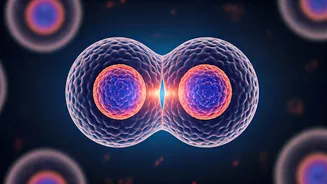

The Cell's Dance
Cell division, a cornerstone of life, is essential for growth, repair, and reproduction. For decades, scientists have relied on specific models to comprehend
this complex process. This involved understanding how a single cell divides into two identical daughter cells. Previously, it was believed that the process followed a specific pathway involving structures like the mitotic spindle, which correctly separates the duplicated chromosomes. However, a recent scientific investigation has challenged the established understanding, leading to a new perspective on how cells actually divide. This shift is not merely a change in scientific theory; it has far-reaching consequences for our understanding of life itself. The implications of this research are significant, prompting scientists to revisit previously held beliefs and consider how this new information will affect future research in the field of biology. The ability of the cell to divide correctly is crucial; errors in this process can lead to various health problems. Therefore, the findings of this scientific study are incredibly important for both theoretical and practical applications.
Unveiling the Mechanism
The research team's exploration of cell division revealed a previously unknown mechanism. The discovery focuses on the precise manner in which chromosomes, carrying genetic information, segregate during division. Scientists have identified that cells use a different process than previously thought to ensure that each daughter cell receives a complete set of chromosomes. This new mechanism involves a more dynamic and intricate interplay of cellular components than previously imagined. The scientists observed the involvement of certain proteins and structures that work together to correctly segregate the chromosomes. This new approach appears to be fundamentally different from the established models of cell division, which means that the current textbooks may need to be updated. It presents a more nuanced view of the process and highlights the incredible complexity of cellular processes. The impact of this finding can be seen in the future, as scientists begin to utilize this information to understand and treat various diseases.
Impact and Future
This groundbreaking discovery has several implications for the scientific community. It challenges existing models and provides a more detailed understanding of cell division. The revelation is expected to influence research in various areas of biology, including cancer research, regenerative medicine, and developmental biology. The newfound knowledge could pave the way for novel therapeutic approaches targeting diseases associated with abnormal cell division. Scientists believe that this new information can revolutionize the way we approach treatments for various diseases. This discovery could also provide a better understanding of how cells react to changes in the environment and how errors in the process of cell division can lead to the development of diseases like cancer. The scientists are now focused on delving deeper into the specifics of this new mechanism. They hope to understand how it functions in different types of cells and organisms. The future seems very promising for scientists who are now using this new information in their research.
Revising Biological Models
The traditional models of cell division have been integral to scientific education for a long time, but now require a reevaluation. The discovery of the new mechanism will be incorporated into the current frameworks, offering a more nuanced and accurate representation of the process. It is anticipated that this will lead to new educational materials and research projects. The aim is to enhance the scientific understanding of this fundamental biological process. As the scientific community delves deeper into this newfound mechanism, it is possible that new information will be discovered. This could lead to a better comprehension of many biological processes and related diseases. This will involve updating textbooks and curricula to reflect the findings, ensuring that future scientists and students are equipped with the most up-to-date knowledge. Ultimately, this will improve our understanding of life itself.
![[WATCH] 'Real Madrid, Ramadan and rest' - Mohammed Siraj how last-minute World Cup call-up changed February plan](https://g-mob.glance-cdn.com/public/fc/image/ByYT_LEmlrD0.webp)