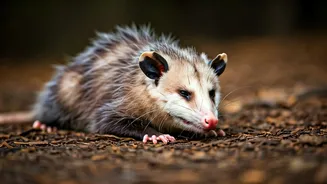

Opossums: Masters of Deception
The opossum is perhaps the most well-known practitioner of thanatosis. When confronted by a threat, it doesn't just pretend; it puts on a convincing performance.
The opossum will fall limp, exuding a foul-smelling substance from its anal glands, which further convinces predators that it is deceased and unappetizing. Its heart rate drops, and it appears lifeless, often lying still for several minutes to hours. This elaborate act works remarkably well against many predators that are not interested in carrion. When the danger has passed, the opossum 'miraculously' revives and scurries away, leaving its baffled predator behind. This is a classic example of how effective playing dead can be, especially against predators that prefer live prey. The opossum's ability to remain still and seemingly lifeless is a testament to its evolutionary adaptation for survival.
Hognose Snakes' Play
Hognose snakes, native to North America, employ a similarly theatrical approach. When threatened, a hognose snake may flatten its neck and hiss, attempting to appear more intimidating. If this doesn't deter the predator, the snake will then roll over onto its back, open its mouth, and begin to thrash around as though in great pain. To further enhance the illusion, it might even emit a foul-smelling musk. If turned over onto its belly, it will promptly flip back over, resuming its 'dead' pose. This behavior, like that of the opossum, is a sophisticated defense mechanism designed to make the predator lose interest. The snake’s varied responses, beginning with displays of aggression and culminating in a convincing performance of death, highlight its ability to adapt and survive against a range of predators. The effectiveness of this tactic lies in its unexpected nature, catching predators off guard and giving the snake a chance to escape.
Frogs: A Sticky Strategy
Some frog species, particularly in the face of danger, also resort to thanatosis. Instead of elaborate theatrics, their tactic is more subtle but effective. These frogs will often become rigid, stopping all movement, and can remain still for significant periods. Some species may also secrete a toxic substance from their skin. This combination of immobility and potential toxicity discourages predators that might otherwise consider them a meal. The strategy is particularly effective against predators that hunt by movement. The frogs' ability to stay still makes them difficult to detect. This strategy highlights that 'playing dead' is not always about a dramatic performance; it can involve merely appearing to be an uninteresting or undesirable target. This approach works well in an environment where predators rely on visual cues.
Insects: Mimicry & Rigidity
Many insect species also utilize thanatosis to evade predators. When threatened, these insects will abruptly freeze, sometimes tucking their legs under their bodies or dropping to the ground. This stillness makes them much harder to spot, especially in environments where they blend in with their surroundings. Some insects, such as certain beetles, may also release a foul odor, increasing the deception. The length of time spent playing dead varies, often depending on the type of predator and the perceived threat. This tactic is extremely useful in deterring predators with short attention spans, especially those that primarily hunt by sight. This form of playing dead is not always about elaborate displays, but it often focuses on simple, effective ways to blend in with the environment, increasing the chances of survival against attacks.
Beetles: The Stiff Act
Several species of beetles are known for their ability to play dead. These beetles often have a very distinct physical response when threatened. They might tuck their legs and antennae close to their bodies and remain perfectly still, often for extended periods. The camouflage often used by beetles further supports their survival strategy. Their ability to go unnoticed in their environment gives them an advantage against a broad range of predators. The success of this approach is in its simplicity and efficiency, especially when combined with natural camouflage or the ability to blend in with the surrounding terrain. This defense mechanism is crucial in environments where predators are abundant, giving beetles a higher chance of escaping danger.