

Stellar Feedback's Role
The birth of stars is a chaotic but crucial cosmic event. As vast quantities of gas and dust collapse under gravity, dense cores form and eventually ignite
nuclear fusion, becoming stars. However, the journey doesn't end there. The very stars being born exert powerful influences on their surroundings. Intense stellar winds, harsh ultraviolet radiation emitted by young, massive stars, and the cataclysmic explosions of supernovas, known collectively as stellar feedback, play a significant role in shaping galaxies. This feedback actively pushes away surrounding gas, a process that effectively limits the amount of material available for subsequent star formation. This delicate balance between star birth and expulsion dictates the pace at which galaxies evolve and grow over cosmic timescales.
Cosmic Dust and Light
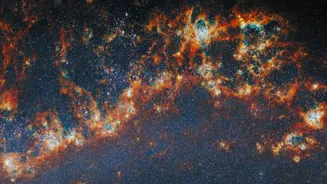
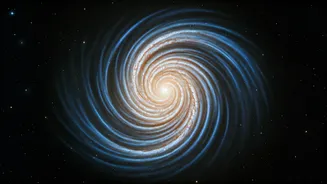
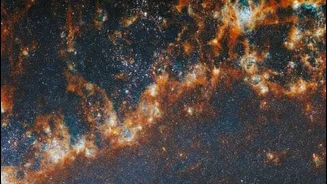
The recent, breathtaking image of the Whirlpool Galaxy, a product of combined data from the James Webb Space Telescope (JWST) and the Hubble Space Telescope, offers an unprecedented view of these processes. JWST's remarkable ability to perceive infrared light is key, allowing it to penetrate the veils of dust that would obscure new star formations from traditional telescopes. In the image, we witness delicate, red-orange tendrils of gas and dust stretching across the frame, interspersed with luminous blue bubbles that suggest internal energy sources. Gaps within this gaseous tapestry reveal brilliant clusters of newly formed stars, shining brightly against the cosmic backdrop. These visual elements highlight the complex interplay of gas, dust, and nascent stellar populations that characterize active galactic regions.
Star Cluster Evolution Timelines
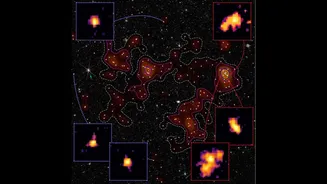
By integrating this detailed view of the Whirlpool Galaxy with other observational data from the same study, astronomers have identified a compelling pattern related to stellar cluster formation. The findings indicate a clear difference in how quickly star clusters of varying sizes emerge from their parent gas clouds. The largest aggregations of stars managed to clear out their birth nebulae in approximately 5 million years. In contrast, smaller stellar groupings required a more extended period, taking between 7 and 8 million years to fully disperse their surrounding gas and become visible. This disparity in timescales has profound implications for our understanding of galactic evolution and a critical period in the universe's history – its reionization.
Reionization: A Cosmic Mystery
Following the initial cooling of the universe after the Big Bang, electrons and protons combined to form neutral atoms. However, a subsequent event, known as reionization, occurred when an as-yet-unidentified energy source managed to re-separate these particles. This transformation dramatically altered the state of the early cosmos. The precise cause of reionization has been a long-standing puzzle. A compelling hypothesis now suggests that the intense ultraviolet radiation emitted by massive star clusters, observed to form and clear their birth clouds relatively quickly, could have been the driving force behind this cosmic reionization. This connection links the intricate processes within galaxies to the large-scale evolution of the universe itself.