





A New Era in Chipmaking
A significant development in the semiconductor industry has emerged with Intel announcing its participation in Elon Musk's ambitious Terafab project. This
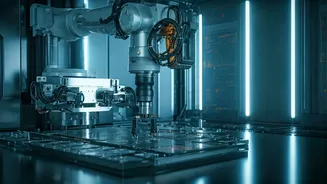
venture is specifically designed to manufacture highly specialized chips essential for powering advanced humanoid robots and large-scale data centers. The collaboration represents a pivotal moment, aiming to accelerate the development and deployment of next-generation AI hardware. Musk's vision for Terafab involves establishing a colossal chip fabrication facility capable of meeting the burgeoning demand for processors tailored to artificial intelligence and robotics applications. Intel's deep expertise in semiconductor design and manufacturing is expected to be instrumental in realizing these innovative goals and bringing Musk's ambitious objectives to fruition.
Strategic Alliance Unveiled
Intel has officially confirmed its role in Elon Musk's Terafab project, joining forces with other entities like SpaceX, Tesla, and xAI. This collaboration marks a strategic move where Intel will contribute its extensive knowledge in processor design and fabrication to support Musk's overarching objective of creating chipsets specifically for humanoid robots and data centers. The Terafab project, initially revealed in March, has set an audacious target to produce over one terawatt of compute power annually. The complexities of chip fabrication are well-known, demanding immense financial investment and years of dedicated research and development. Intel's decision to join, as communicated via X, underscores its commitment to 'refactor silicon fab technology,' positioning it as the first external company and the sole active chip fabricator to partner in this endeavor.
Future of Silicon Manufacturing
The CEO of Intel expressed enthusiasm for the partnership, highlighting Elon Musk's remarkable ability to redefine entire industries, a quality deemed vital for the current state of semiconductor manufacturing. The Terafab initiative is seen as a transformative step in how silicon logic, memory, and packaging will be produced in the future. Intel is proud to be a collaborator, working closely with Musk on what is considered a highly strategic project. Musk first introduced Terafab on March 22, setting a goal of exceeding one trillion watts of compute per year. His plan involves creating two separate fabrication plants, with each facility dedicated to a singular chip design to streamline the manufacturing process. He further elaborated that the research fab within Terafab would facilitate daily iteration of new chip designs, enabling rapid experimentation and faster identification of effective designs, though these ambitious claims have also sparked debate among industry experts.
Location and Timelines
The initial two Terafab factories are slated for construction in Austin, Texas, a location chosen for its burgeoning tech ecosystem and potential for specialized workforce development. However, Elon Musk has not yet provided a definitive timeline for when these advanced manufacturing facilities are expected to become operational. Intel has publicly confirmed its participation in Terafab, alongside SpaceX, xAI, and Tesla, solidifying the collaborative nature of this groundbreaking project. This alliance appears to be a strategic response by Intel, especially considering the significant advancements made by competitors like Nvidia and AMD in the lucrative AI chip market, areas where Intel has historically sought to strengthen its position. By securing a foundational role in the Terafab project, which is focused on developing compute power for both robotics and AI data centers, Intel aims to establish a crucial anchor client for its foundry business within this rapidly evolving sector.