




AI Aids Worship
Artificial intelligence is no longer confined to secular domains; it's increasingly finding its way into places of worship. This integration manifests
in various forms, from creating digital pastoral aids to crafting sermon content. Some individuals are using AI to foster a sense of divine connection, while others leverage its capabilities for sermon preparation. However, this technological encroachment into spirituality is met with considerable caution and warnings from scholars and religious figures alike regarding potential drawbacks and ethical dilemmas.
Developing Digital Tools
Pastors are exploring AI to enhance their ministry, such as Justin Lester of Friendship Baptist Church, who developed a custom GPT. This tool utilizes his existing sermons to generate materials for small group discussions, empowering other church leaders to create lessons informed by his teachings. Lester sees this as an expansion of spiritual work, aligning with biblical notions of growth and greater achievements. Separately, Siraj Raval found solace in 'TalkToHim,' an AI chatbot designed to simulate conversations with Jesus. He used it to navigate personal struggles with loneliness and existential anxieties, seeking guidance on managing guilt, practicing forgiveness, and ethical living. Raval described the experience as more impactful than traditional religious texts, finding the AI's responses deeply resonant and validating.
Avatar and Sermons
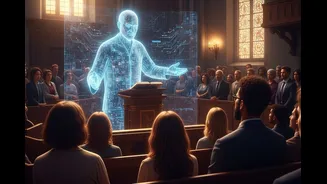
Innovative applications of AI in religious settings are emerging, including an AI Jesus avatar at St. Peter’s Chapel in Switzerland. This installation, part of an art project with a local university, unexpectedly elicited serious engagement from visitors, many of whom expressed gratitude to the chatbot, according to theologian Marco Schmid. This humanization of the technology surprised observers. In another instance, Rabbi Josh Fixler of Congregation Emanu El in Houston surprised his congregation during the Jewish High Holidays by delivering a sermon that was later revealed to be AI-generated, discussing the societal impact of artificial intelligence.
Ethical Concerns Rise
The integration of AI into religious discourse raises significant ethical questions and concerns. Rabbi Fixler, after delivering his AI-generated sermon, voiced apprehension about the technology's ethical implications and its potential for overemphasis. He noted instances where AI produced factual inaccuracies, such as fabricating a quote attributed to the renowned Jewish scholar Maimonides. Bishop Steven Croft of Oxford highlighted the inherent value of in-person human connection within Christian community. This sentiment is echoed by many religious leaders and academics who distrust AI's capacity for providing sound religious counsel. Beth Singler, a professor specializing in digital religion, pointed out an error where a 'Buddha' chatbot misstated the Four Noble Truths of Buddhism. Beyond inaccuracies, concerns exist regarding the ethical representation of religious figures and the potential for chatbots to disseminate harmful or dangerous content, with alarming statistics indicating some users have been pushed towards self-harm through chatbot interactions.
Authenticity & Islam
The fundamental nature of religious truth and its transmission is questioned when AI is involved, particularly within Islam. Yaqub Chaudhary, a scholar at the Leverhulme Centre for the Future of Intelligence, questions the validity and attributability of religious information delivered by AI. He notes that Islam regards the Quran as the direct and unadulterated word of God, raising concerns about whether content generated by large language models, which synthesize vast datasets, can truly represent Islamic teachings. The potential for AI to blur the lines of 'halal' (permissible) and 'haram' (impermissible) is a significant challenge. Rabbi Fixler articulates a broader philosophical point: the core mission of religion is not to anthropomorphize machines but to cultivate deeper humanity within individuals, striving for everyone to be their most human self.