






Quantum Leap in Batteries
Scientists have achieved a significant milestone in the pursuit of quantum batteries, successfully demonstrating a functional prototype that can absorb,
retain, and then release electrical energy. This novel approach sidesteps the traditional chemical reactions that power conventional batteries, instead harnessing the peculiar principles of quantum mechanics, such as superposition and entanglement. This fundamental difference opens the door to vastly accelerated charging times and the potential for considerably higher energy storage densities. While the widespread availability of these quantum powerhouses is still some way off, advancements like this are rapidly bringing this theoretical concept closer to practical application, promising to reshape how we conceive of and utilize energy storage in the future.
Scalable Charging Advantage
A remarkable discovery emerged from the development of this quantum battery prototype: the charging speed isn't constant; rather, it accelerates as the battery's size increases. This behaviour is fundamentally different from conventional batteries, which typically exhibit diminishing returns in charging speed as they scale. This unique scalability suggests that larger quantum batteries could eventually surpass the performance of current energy storage technologies in terms of efficiency and rapidity of charge. This finding, noted by PhD candidate Daniel Tibben, underscores the significant advantages inherent in quantum battery design and points towards a future where energy demands can be met with unprecedented speed.
Proof-of-Concept Realized
The presented prototype represents the most tangible realization to date of a functioning quantum battery. Researchers have successfully engineered a device that performs the core functions of charging, storing energy, and subsequently discharging it. This achievement, spearheaded by a collaboration between CSIRO, RMIT University, and the University of Melbourne, marks a critical step in transitioning quantum batteries from theoretical constructs to demonstrable laboratory realities. This interdisciplinary effort has laid crucial groundwork in a burgeoning scientific field, moving the concept from abstract discussion to concrete engineering.
Quantum Mechanics at Play
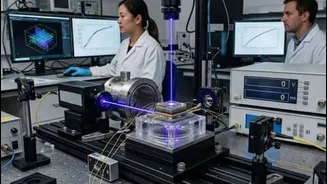
The operational framework of quantum batteries diverges significantly from standard batteries. Instead of relying on electrochemical processes, they exploit quantum phenomena like superposition and entanglement. The specific prototype developed is a compact, multi-layered organic structure that can be replenished with energy wirelessly, utilizing a laser as the charging source. This method of energy transfer and storage is governed by the fundamental laws of quantum physics, allowing for novel and potentially more efficient energy dynamics compared to classical systems.
Future Energy Horizons
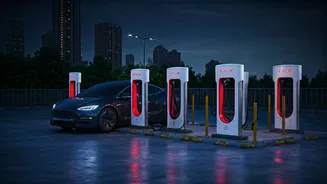
This proof-of-concept device showcases the potential for rapid and scalable energy storage, even at ambient room temperatures, setting the stage for next-generation energy solutions. Although substantial research remains to fully harness quantum batteries, this development is a pivotal stride towards their practical implementation. The ultimate aspiration is to enable applications such as vastly accelerated electric vehicle charging or even long-distance wireless power transmission. A key area of ongoing research focuses on extending the duration for which these quantum batteries can hold stored energy, a crucial step for their eventual commercial viability and widespread adoption.