




Starship's Orbital Advantage
The immense distance to Uranus has historically made missions there a multi-decade endeavor. However, the development of SpaceX's Starship presents a paradigm
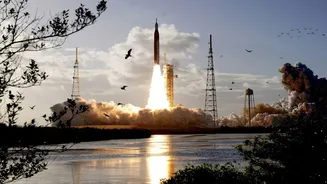
shift. Its unique design, engineered for in-orbit refueling, means the spacecraft can depart Earth with a full fuel load, enabling a more direct and rapid trajectory to distant celestial bodies. Research, including studies from MIT scientists, suggests that Starship could facilitate a direct flight to Uranus, potentially completing the journey in as little as six years. This is a remarkable reduction compared to current mission timelines. Furthermore, Starship's substantial size and power capacity allow for the transport of larger payloads, which is crucial for advanced scientific instruments and supplies needed for extended deep-space exploration. This enhanced capability opens up new possibilities for comprehensive study of the outer Solar System.
Challenges of Deep Space Travel
Uranus is an exceptionally distant planet, situated approximately 19 times further from the Sun than Earth. This vast gulf has been the primary obstacle for interplanetary missions. Historically, the only probe to have successfully reached Uranus, NASA's, took over nine and a half years for a brief flyby. Even proposed modern alternatives have struggled to significantly improve these times. For instance, concepts utilizing powerful rocket boosters like Falcon Heavy, even with extensive gravity-assist maneuvers to conserve energy, projected voyage durations around 13 years. Such extended travel periods introduce numerous logistical and scientific challenges. They increase mission costs, raise the risk of losing valuable expertise due to long separations from Earth, and can delay the acquisition of crucial scientific data. Therefore, minimizing the time it takes to reach these far-flung destinations is paramount for the success and efficiency of future exploration.
The Importance of Swift Exploration
Until now, Uranus has remained one of the least explored planets within our Solar System. Our understanding of this ice giant is limited, largely based on a single, brief flyover conducted nearly forty years ago. Yet, Uranus holds immense scientific intrigue due to its peculiar axial tilt, unusual magnetic field, and the potential for subsurface liquid water oceans on some of its moons. These characteristics make it a prime candidate for investigating the possibility of extraterrestrial life. A recent consensus in the scientific community, highlighted by the 2022 Planetary Science Decadal Survey, identified a mission to Uranus as a top priority for exploration. Halving the transit time would yield significant benefits, including accelerated scientific discoveries, reduced mission risks, and improved opportunities for observation during specific planetary alignments. This advancement could fundamentally alter how we approach and execute missions to Neptune and beyond, marking a new era in human exploration of the cosmos.