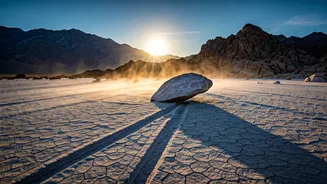









A Desert Enigma
Death Valley National Park in California is well-known for its extreme conditions, including scorching temperatures and arid landscapes. Within this environment
lies an even more peculiar phenomenon: the sailing stones. These rocks, weighing hundreds of pounds, appear to move across the vast, flat surface of Racetrack Playa, leaving behind distinct trails. For many years, the cause of their movement remained a complete mystery, becoming a topic of discussion among scientists and enthusiasts alike. The phenomenon's unpredictable nature made it exceedingly difficult to observe the stones' movement and gather data in real-time. Scientists had to rely on observations, photographs, and educated guesses to figure out how these rocks could move across the desert floor without any visible external force. This perplexing puzzle has captured the imagination of many.
The Scientific Breakthrough
After numerous theories and investigations, researchers have finally unraveled the secret behind the sliding rocks. The crucial elements turned out to be a specific sequence of natural events. It starts with the arrival of overnight freezing conditions that create a thin layer of ice on the playa. As the sun rises, this ice starts to melt. This action transforms into large, thin ice sheets. These are accompanied by strong winds that begin to blow across the surface. These wind gusts, combined with the slippery ice, provide the necessary force to move the rocks, and leave a trail behind as they move. The interplay of these conditions is rare, but when the circumstances align, it results in the mysterious and fascinating movement of the Death Valley sliding rocks.
Ice and Wind's Role
The exact combination of ice and wind is responsible for the rocks' movement. Scientists have learned that the specific type of ice forming on the playa is critical. When temperatures drop below freezing, a layer of thin ice forms on the surface. As this ice begins to melt during the day, it becomes a crucial element. Strong winds then come into play, blowing across the wet, icy surface. The combination of ice sheets and wind generates the necessary conditions for the rocks to move, as they are pushed across the slick surface. The researchers noted that the wind must be strong enough to overcome the friction between the rocks and the ice, but not so strong that it causes the rocks to tip over. This nuanced interplay of conditions is the main factor.
Unveiling the Trails
The trails left behind by the sliding rocks are the most prominent evidence of their movement. The trails vary in length and curvature, indicating the rocks' paths and the influence of wind. The trails often appear shallow, demonstrating how the rocks glide over the surface with minimal friction. Analyzing these trails has also provided critical information about the movement. By studying the direction, shape, and length of the trails, scientists have been able to deduce the types of rocks, the force of the wind, and the conditions on the playa during the events. These trails provide a visible record of the rocks' movements, giving scientists a lot of data to analyze and understand this rare occurrence. The unique patterns are essential to piecing together the events that led to the rocks' movements.
A Decade-Long Mystery Solved
The discovery offers a conclusion to decades of speculation and investigation. This solution gives scientists a more profound comprehension of natural forces. The revelation highlights the importance of observation and persistence in scientific research. This research also demonstrates that even in seemingly static environments, dynamic processes can occur, driven by complex interactions. Moreover, it exemplifies the significance of interdisciplinary collaboration, as meteorologists, geologists, and other specialists had to contribute to solve the mystery. This breakthrough also showcases the power of scientific investigation to reveal the hidden complexities of the natural world, fostering a greater appreciation for the delicate balance of environmental factors that shape our planet.