






Hybrid Energy Innovation
A significant leap in renewable energy has been achieved by researchers at the Institute of Materials Science of Seville (ICMS). They have developed a novel
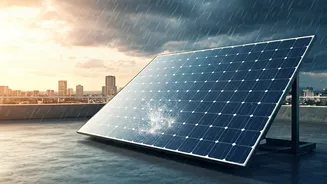
thin-film technology integrated into solar panels, enabling them to generate electricity from two distinct environmental sources: sunlight and falling raindrops. This ingenious hybrid device merges the capabilities of solar power generation with triboelectric nanogenerators, unlocking previously underutilized energy potential. The core of this advancement lies in a patented thin film designed not only to protect delicate perovskite solar cells and enhance their resilience against harsh weather conditions but also to serve as a triboelectric surface. This dual-functionality means the same panel can harvest solar energy efficiently and simultaneously convert the impact of raindrops into a substantial electrical output, generating over 100 volts from a single drop, which is ample for powering small electronic gadgets. This breakthrough addresses a critical limitation of traditional solar energy, which is its dependency on clear skies.
Advanced Perovskite Protection
Perovskite solar cells, known for their excellent sunlight absorption capabilities and potentially lower manufacturing costs compared to silicon, face a significant challenge: their susceptibility to environmental degradation. To overcome this, the ICMS research team has pioneered the use of plasma technology to apply an ultra-thin protective coating, approximately 100 nanometers thick, onto these cells. This specialized coating performs a dual critical function. Firstly, it acts as a robust shield, offering chemical protection and improving the material's light absorption efficiency. Secondly, and crucially for the hybrid functionality, this surface possesses triboelectric properties. When raindrops strike this surface, friction and contact generate an electrical charge, effectively converting the mechanical energy of the rain into usable electricity. This innovative coating has demonstrated remarkable durability, remaining stable even when fully submerged in water and enduring rigorous temperature and humidity cycles. It has been shown to continuously power simple electronics like LED circuits, proving its efficacy in real-world conditions.
Consistent Power Solution
The limitations of current energy storage systems, such as traditional batteries, and the inherent inefficiency of solar panels during overcast weather have long been recognized. This new hybrid technology offers a compelling solution by harnessing both solar and rain energy, thereby ensuring a more consistent and uninterrupted power supply. The primary objective behind this innovation is to enable portable and wireless devices to operate continuously, irrespective of fluctuating weather patterns. The researchers envision this technology being particularly beneficial for a wide array of Internet of Things (IoT) applications. This includes environmental monitoring sensors that track conditions like humidity, rainfall, and air quality, as well as structural sensors deployed on bridges and buildings for integrity checks. Additionally, it holds promise for weather stations, precision agriculture systems, and even within smart city infrastructure for applications such as autonomous auxiliary lighting, signage, and continuous monitoring systems. Its resilience to adverse weather conditions makes it ideal for remote or inaccessible locations, including marine stations, offering a sustainable power source where traditional grids are not feasible.
Toward Autonomous Systems
This groundbreaking research represents a paradigm shift in the development of self-powered electronic systems designed specifically for outdoor environments. By creating durable and autonomous devices, the technology aims to reduce reliance on conventional power sources and their associated maintenance challenges. The researchers highlight the significant potential of coatings applied through plasma deposition techniques as a versatile, multifunctional solution. This approach not only safeguards sensitive energy-harvesting devices from environmental damage but also actively develops systems capable of collecting energy from multiple natural sources. The concept of 'rain panels,' essentially hybrid solar-rain energy harvesters, exemplifies this forward-thinking strategy. The successful implementation of this technology, supported by projects funded by the European Research Council and Next Generation funds, underscores the viability of generating power from diverse environmental phenomena, pushing the boundaries of what is possible in sustainable energy generation and autonomous electronic systems.