







What is Cave Popcorn?
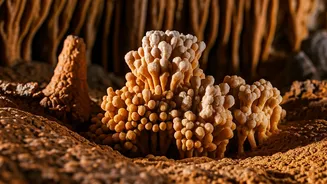
Cave popcorn, a captivating geological feature, presents itself as knobby clusters of minerals that festoon the walls and ceilings of subterranean environments.
These formations are not confined to blank surfaces; they frequently encase or grow upon other established cave deposits, such as delicate stalactites and robust stalagmites. Its appearance can vary significantly, sometimes manifesting as densely packed, minuscule bumps that collectively evoke the rough texture of a cauliflower. In other instances, it adopts a more pronounced, cherry-like globular form, creating distinct, larger blobs. Collectively, these bulbous cave growths, including cave popcorn, are categorized under the broader term 'coralloids', a testament to their often intricate and branching appearances reminiscent of marine coral.
Formation Processes Explained
The genesis of cave popcorn is intrinsically linked to the slow, deliberate interaction of mineral-laden water with the cave's environment. Predominantly, these formations arise from a process driven by evaporation. Over extended periods, spanning hundreds or even thousands of years, water rich in dissolved minerals splashes or gently seeps onto cave surfaces. As this water encounters the drier cave air, it gradually evaporates, leaving behind the dissolved minerals. This continuous cycle of deposition and evaporation leads to the gradual accumulation and clumping of these minerals, ultimately shaping the characteristic popcorn-like structures. While evaporation is the primary driver, a secondary formation method occurs entirely submerged. This underwater genesis takes place when cave water becomes supersaturated with minerals, meaning it holds more dissolved minerals than it normally can. Under these conditions, the excess minerals can precipitate out of the solution, forming deposits that mimic the appearance of popcorn.
Growth Rate and Composition
The growth of cave popcorn, much like other speleothems, is an incredibly slow phenomenon. It is estimated that these mineral formations expand at a rate of approximately 1 centimeter, or about half an inch, every 100 years. This glacial pace underscores the ancient nature of cave environments and the slow, persistent geological processes at play. The primary constituents of most cave popcorn are calcium-based minerals, with calcite and gypsum being the most common. These minerals typically impart a whitish or off-white hue to the formations. However, the mineral composition can vary significantly depending on the specific cave and its geological makeup. In some caves, formations may be composed of different minerals, such as salt deposits, which can lead to distinct appearances and properties. The bright appearance of cave popcorn can diminish over time due to changes in water flow and a slowdown in its growth, causing it to darken. Additionally, the presence of certain elements can introduce vibrant colors; for instance, iron can lend an earthy, reddish tint to the formations.
Vibrant Colors and Global Examples
While typically whiteish due to common calcite and gypsum compositions, cave popcorn can exhibit a spectrum of colors influenced by trace elements within the mineral-rich water. Iron, for example, is often responsible for imparting earthy reddish and brownish hues, adding a rustic charm to these subterranean decorations. Conversely, the intensity of color can also be affected by the dynamics of water flow and the stage of formation. Initially bright, formations might darken as their growth rate slows or water sources change. Intriguing examples of cave popcorn and other salt-crystal formations can be found in subterranean environments worldwide. A notable instance is within Poland's Wieliczka Salt Mine, where not only cave popcorn but also delicate straws and various other mineral structures, all composed of salt crystals, adorn the mine's expansive surfaces, showcasing the diverse mineralogy possible in these underground realms.