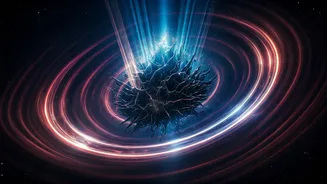








Dark Matter's Mysteries
The James Webb Space Telescope (JWST) is opening new avenues for understanding the enigmatic substance known as dark matter. Scientists are hopeful that
JWST's unique observational capabilities will enable them to delve into the mysteries of dark matter. Dark matter, which constitutes a significant portion of the universe's mass, remains largely invisible, making it an ongoing subject of research. The JWST may allow scientists to analyze distant galaxies and the behavior of light, potentially revealing new clues about dark matter's characteristics and its role in the universe's structure. These observations could lead to a deeper understanding of the universe's composition and evolution, providing insight into phenomena such as how galaxies form and cluster, which are directly influenced by the distribution of dark matter.
Solar Wind's U-Turn
NASA's Parker Solar Probe has made a remarkable discovery, observing a 'U-turn' in the solar wind, which is a stream of charged particles constantly released by the sun. This observation offers crucial insights into space weather patterns, which can significantly affect technology on Earth. Understanding the behavior of the solar wind is critical for predicting and mitigating the effects of solar flares and coronal mass ejections. These events can disrupt satellite communications, power grids, and other essential systems. The Parker Solar Probe's findings are enhancing space weather forecasting models. By analyzing the mechanisms behind the solar wind's reversal, scientists hope to gain a more comprehensive understanding of how solar activity impacts Earth and the surrounding space environment. Ultimately, this knowledge will improve the ability to protect critical infrastructure from the damaging effects of space weather events.
Mars' Cosmic Butterfly
A city-size 'cosmic butterfly' crater has been discovered on Mars by the European Space Agency (ESA). This crater has revealed signs of ancient water on the planet. The crater's distinct shape resembles a butterfly, with smooth 'wings' likely shaped by the presence of water in the past. These findings add to the evidence of a potentially habitable environment on Mars billions of years ago. The presence of water is a key indicator for potential past or present life. The ESA's investigation of the crater could help scientists understand the geological history of Mars and assess its potential to have supported life. The discovery is significant as it provides crucial data about Mars' environmental evolution and the possibility of finding traces of past microbial life.
Comet 3I/ATLAS' Approach
The interstellar comet 3I/ATLAS made its closest approach to Earth on December 19th, offering a rare opportunity for scientists to study a celestial visitor from outside our solar system. This comet's trajectory and composition can provide valuable information about the formation of planetary systems and the conditions in interstellar space. Scientists utilized telescopes and advanced observational techniques to study the comet. The data collected from comet 3I/ATLAS helps scientists understand the diversity of comets and the materials that exist in the vast expanse of space. Every comet carries a frozen snapshot of the early solar system, making its study imperative for understanding the origins of planets and the fundamental elements of life, potentially offering insights into the formation of other planetary systems.
European Rocket Launch
Europe's Ariane 6 rocket successfully launched its first pair of Galileo navigation satellites. This milestone strengthens Europe's independent navigation capabilities. The Galileo system offers advanced positioning services and is critical for both civilian and military applications. The launch marks a significant advancement for Europe's space program. It ensures Europe's continued access to crucial navigation technologies and strengthens its position in the global space market. Further, the deployment of Galileo satellites bolsters the reliability and precision of navigation and timing data. This is crucial for applications that require accurate location information, from transportation and logistics to emergency services and scientific research.