








Trees as City Coolers
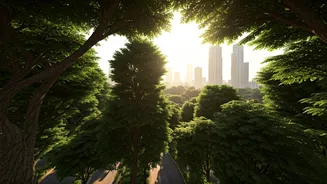
A groundbreaking study underscores the immense power of urban trees in combating the 'Urban Heat Island' (UHI) phenomenon. These natural assets effectively
narrow the temperature disparity between built-up urban centers and their surrounding rural areas, reducing it by nearly half. Trees perform this cooling magic through two primary methods: providing direct shade, which prevents surfaces like pavement and buildings from absorbing excessive solar radiation, and transpiration, a process where trees release water vapor into the atmosphere, acting as a natural evaporative cooler. Research published in Nature Communications, which analyzed data from 8,919 large urban areas using satellite imagery and climate modeling, revealed that existing urban tree cover is responsible for mitigating between 41% and 49% of the maximum potential UHI. Without this green infrastructure, cities would experience heat intensities twice as severe as they currently do. This cooling effect translates to an average reduction in summer air temperatures by 0.15 degrees Celsius, a significant benefit for urban dwellers. The findings strongly advocate for increasing tree populations within cities to enhance public health and create more livable environments.
The Cooling Divide
The benefits of urban greenery are not distributed equally, creating a stark 'cooling divide' that disproportionately affects vulnerable populations. The research highlights a significant disparity between high-income and low-income nations regarding access to the cooling advantages provided by trees. While nearly 40% of cities in wealthier countries experience substantial temperature reductions thanks to their tree canopies, less than 9% of cities in poorer nations benefit similarly. This is particularly concerning in rapidly developing urban areas across the Global South, such as Dakar and Port-au-Prince, where the presence of trees is minimal, offering almost no relief from rising temperatures. Consequently, residents in these areas, often comprising the most socio-economically disadvantaged communities, are placed at a heightened risk of heat-related illnesses and mortality. This inequitable distribution of natural cooling mechanisms exacerbates existing public health crises, emphasizing the urgent need for targeted urban greening initiatives in underserved communities.
Limits of Green Solutions
While the importance of urban forests for moderating city temperatures is undeniable, it is crucial to recognize their limitations in addressing the larger scale of global climate change. Scientists have explored scenarios where cities maximize their tree cover to its fullest potential. However, even in such idealized situations, the additional cooling achieved would only be around 0.3 degrees Celsius. This is a minuscule amount when compared to the projected global temperature rise, which is estimated to be between 1.5 and 2.4 degrees Celsius by 2050. The study, published in Nature Communications, clearly indicates that trees, though vital for urban livability, cannot single-handedly counteract the profound warming caused by pervasive greenhouse gas emissions stemming from human activities like burning fossil fuels. Therefore, while continuing to expand urban forestry is essential for public health and local climate adaptation, it must be complemented by aggressive global strategies to drastically reduce carbon emissions.
Strategic Planting for Resilience
Future urban planning strategies must adopt a more targeted approach to green infrastructure, focusing on 'strategic planting' to protect the most vulnerable neighborhoods. By analyzing where urban heat is most severe and where tree cover is lacking, cities can prioritize the expansion of green spaces in high-risk zones. This means increasing tree density in low-income areas and communities that historically have had fewer trees, thereby directly mitigating heat exposure during dangerous heatwaves and potentially saving lives. However, the effectiveness and survival of these newly planted trees are intrinsically linked to broader climate action. Extreme heat events and prolonged droughts, exacerbated by climate change, pose a significant threat to the very trees intended to provide relief. Thus, the success of urban greening initiatives, especially those aimed at protecting at-risk populations, is contingent upon simultaneously addressing the root cause of climate change: global carbon emissions. This dual approach ensures that our green solutions are both effective and sustainable in the long run.