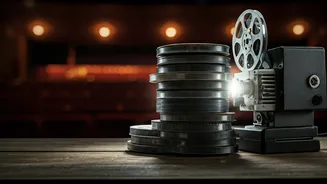






Early Cinematic Wonders
The early days of cinema were filled with remarkable developments, even on a day such as Monday, January 12th. Think about the impact these movies had,
such as 'The Jazz Singer' from 1927, which was a pivotal film because it was the first feature-length motion picture with synchronized singing and dialogue. This marked a monumental shift in how films were made and perceived. Another early milestone, 'Birth of a Nation' in 1915, despite its controversial themes, showcased innovative filmmaking techniques that influenced the evolution of visual storytelling. Early cinema also saw the rise of iconic figures like Charlie Chaplin, whose silent films used physical comedy to make audiences laugh. Early movies were not only about storytelling, but also about the technical challenges. Filmmakers had to figure out how to capture movement, create special effects and record sound and dialogue. These efforts laid the groundwork for the industry we know today.
Behind-the-Scenes Secrets
Many films have interesting facts hidden away from the public. Take, for instance, the intense atmosphere of filming. A classic example is the production of 'The Wizard of Oz' in 1939. The film was known for its technical innovations, such as the use of Technicolor, which was expensive and challenging to manage. The actors experienced a demanding work environment, with intense heat from the studio lights and the pressure of meeting tight deadlines. Moreover, many actors encountered problems with their makeup and costumes, sometimes leading to health issues. The set also faced production problems, including injuries and technical issues that added to the stress. Another memorable example is 'Casablanca' (1942), where the challenges during filming were due to casting choices. The film's rushed production schedule meant that the actors had little rehearsal time, making it challenging to perfect their on-screen chemistry. The film's success against the odds shows the ability to overcome those challenges.
Character Quirks Revealed
Movie characters have fascinating secrets. Take the characters in 'Star Wars,' and consider the unique traits they portray. Take the case of the characters and their breath, the state of their oral hygiene, and you might learn something. Darth Vader's breathing apparatus, for instance, is iconic, yet one has to imagine it might create a rather unpleasant smell. Similarly, the Wookiee Chewbacca, despite his generally friendly demeanor, could perhaps be harboring some unpleasant odors, as a result of his lifestyle. Another character, Jabba the Hutt, with his gargantuan size, surely would have had significant breath-related concerns. The film characters offer a fascinating window into film trivia, and give insights into how filmmakers use the smallest details to bring characters to life.
Movie Flops, Unexpectedly
Even the most ambitious projects can sometimes fail. A look at some famous movie flops reveals a myriad of reasons for failure. Several movies, like 'Ishtar' (1987), suffered from high production costs and a negative critical response. The film was over budget and failed to connect with audiences, leading to substantial financial losses. Other films, such as 'Heaven's Gate' (1980), were negatively affected by their long production times and creative disagreements. The film's excessive runtime and extensive revisions failed to engage audiences, adding to the box office failure. Moreover, a few movies were affected by unforeseen problems, like 'The Adventures of Baron Munchausen' (1988), which was damaged by budget increases and on-set conflicts. The film's production troubles significantly impacted its ability to gain critical or commercial success.
Adaptations in Limelight
Adapting comic book characters for film is often a challenge. Some adaptations, however, have not been successful. For instance, the original 'Fantastic Four' film (1994), which was never officially released, was made on a very low budget and had poor special effects, leading to a negative reception. Another character that faced adaptation challenges was Elektra, whose solo film (2005) suffered from poor reviews and box office failure. It didn't capture the essence of the character from the comic books, adding to its failure. Also, 'Catwoman' (2004) faced challenges because it was far removed from the source material and received very critical reviews from audiences and critics alike. These examples show how complicated and sensitive the process of bringing characters from comics to the screen can be.
Movies from Video Games
Many video games have been adapted into films and TV shows. Some examples are: 'The Last of Us,' which was transformed into an acclaimed TV series and was praised for its faithful adaptation of the original game, and 'Sonic the Hedgehog,' which became a success at the box office, combining humor and action. Other games such as 'Uncharted' saw an action-packed movie version, highlighting the game's adventurous spirit, and 'Resident Evil,' which spawned a film franchise with several instalments, bringing the game's horror aspects to life. Furthermore, some video games did not receive an on-screen adaptation, such as 'Half-Life,' 'Portal,' and 'BioShock,' demonstrating that the transition from game to screen is not always guaranteed.
Comedy Moments in Film
Comedy has a pivotal role in films, offering laughter. Tina Fey, for example, had made predictions. Similarly, the satire and wit found in shows such as 'South Park' show a knack for social criticism. Their willingness to take on current events, sometimes resulting in controversy, shows how comedy can reflect societal views. Also, the Golden Globes, and the comments made by Nikki Glaser, illustrate how comedy can be employed in ceremonies, creating moments that the public can look back upon.