






Dark Matter Unveiled
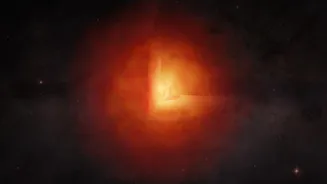
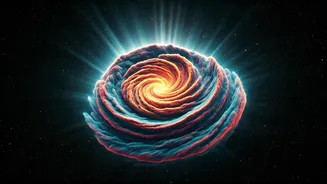
The groundbreaking discovery by the Hubble Telescope centers on a starless dark matter cloud. Dark matter, a mysterious substance making up a substantial
portion of the universe's mass, is largely invisible, interacting only through gravity. Its detection requires indirect methods. The Hubble's capacity to observe gravitational lensing – the bending of light by massive objects – played a crucial role in identifying this cloud. These observations have allowed scientists to study the distribution and properties of dark matter. This discovery provides fresh insights into how dark matter is distributed throughout the universe and its role in shaping galactic structures. The existence of a starless cloud indicates a unique environment with implications for galaxy formation and cosmic evolution.
Hubble's Observational Power
The Hubble Space Telescope's success in finding this dark matter cloud is a testament to its advanced capabilities. Located in Earth's orbit, it bypasses atmospheric interference, allowing for detailed astronomical observations across various wavelengths. For this detection, Hubble used its high-resolution cameras to analyze the distortion of light from distant galaxies, a technique called gravitational lensing. By measuring the degree of light bending, astronomers can estimate the amount and distribution of dark matter along the line of sight. This technique allows scientists to effectively "see" what is otherwise invisible. The telescope's longevity and continuous upgrades have enabled it to gather vast amounts of data, contributing significantly to our understanding of the universe. The discovery underscores Hubble's critical role in exploring the cosmos.
Cosmological Implications
The discovery of a starless dark matter cloud presents profound implications for cosmological models. It challenges our understanding of dark matter's behavior and distribution. Current theories predict certain distributions of dark matter within the universe, and the observations may lead to revisions. This particular cloud's existence could influence how scientists model the formation of galaxies and the larger-scale structure of the cosmos. Astronomers will now need to revisit and possibly revise models, incorporating these new observations into simulations. The research encourages scientists to delve deeper into the nature of dark matter, hoping to uncover its composition and properties. The ongoing analysis of data from the Hubble Telescope and other observatories will be critical in advancing our understanding of this enigmatic component of the universe.
Future Research Directions
This discovery opens doors for future research focused on understanding dark matter and its role in the universe. Scientists plan to use this finding to perform deeper investigations. One primary area of focus will be to characterize the cloud's properties, including its density, size, and interaction with other matter. Researchers will use the Hubble and other telescopes to carry out further observations, and advanced analysis techniques will be needed to interpret the data. Another direction is to investigate how dark matter interacts with ordinary matter, helping to uncover the mechanisms that shape galaxies and influence cosmic structures. Furthermore, these findings should encourage the development of new theoretical models to account for the observed dark matter distribution. As technology advances, more powerful telescopes and instruments will be deployed, offering unprecedented opportunities for exploring the universe's secrets and gaining a more complete understanding of dark matter.