
Early Universe Glimpses
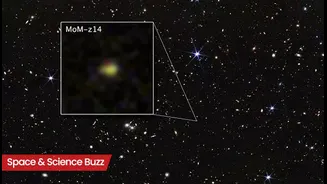
JWST is providing unprecedented views of the early universe, allowing scientists to peer back in time and witness events that occurred shortly after the Big
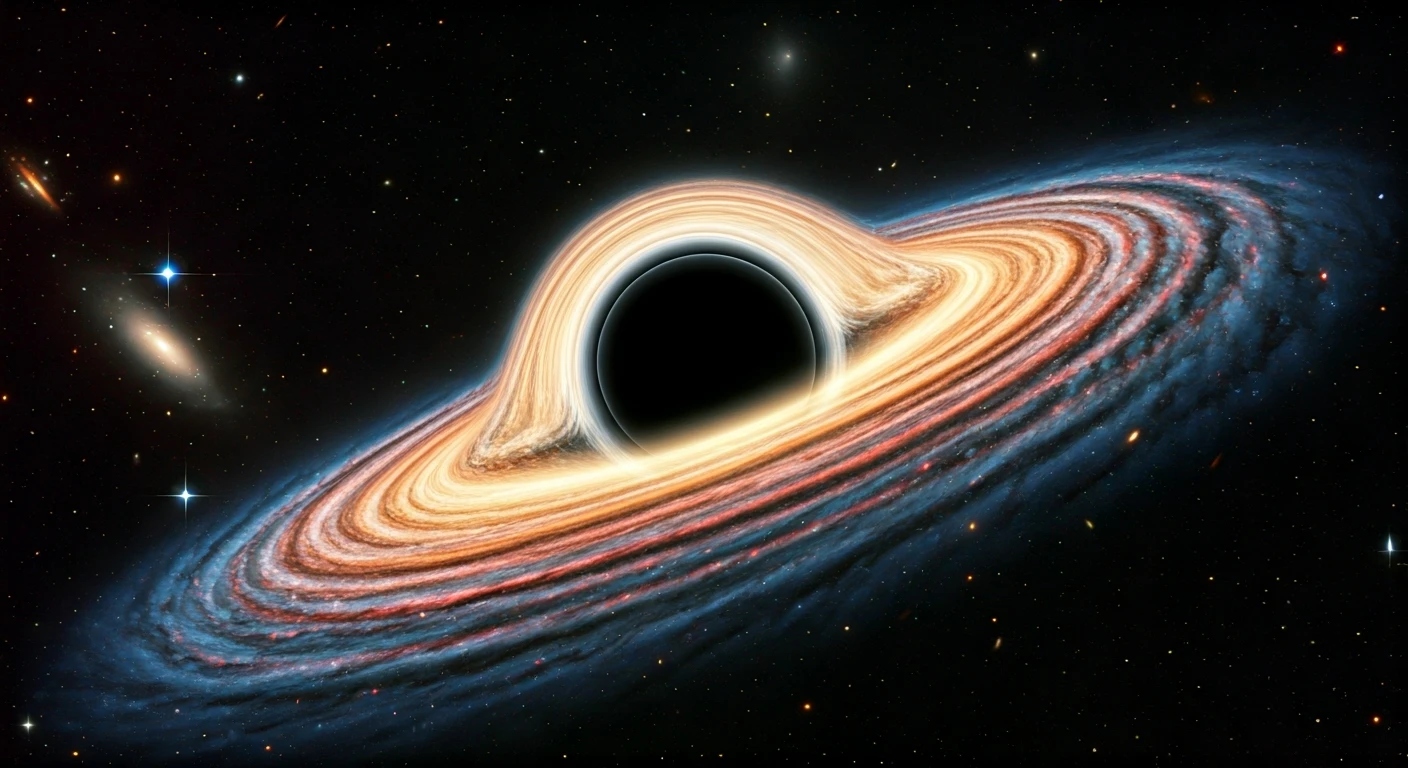
Bang. Its advanced infrared capabilities enable it to detect the faint light from distant galaxies and study the environments where the first supermassive black holes (SMBHs) were born. The telescope's ability to see through cosmic dust clouds gives a clearer look at the galaxies where SMBHs reside, offering clues about their formation and growth. These observations are critical because SMBHs, millions or even billions of times the mass of our sun, are found at the centers of nearly all large galaxies, including our own Milky Way. Therefore, studying their origins offers a pathway to understanding how galaxies themselves evolved over billions of years.
Unveiling Black Hole Origins
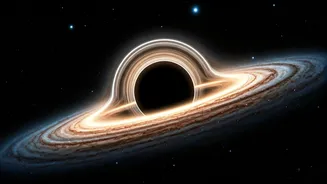
One of the key questions JWST is helping to answer is how these SMBHs formed so early in the universe's history. Observations show SMBHs already existed when the universe was less than a billion years old. There are several theories about the origin of these massive objects. One idea suggests SMBHs formed directly from the collapse of massive gas clouds. Another proposes that SMBHs emerged from the remnants of the first generation of stars, which then merged and grew over time. JWST data is being used to test these theories by examining the properties of the galaxies and their central black holes. The data includes the masses of the black holes, their accretion rates (how much matter they are consuming), and the properties of the surrounding galaxies, such as their star formation rates and gas content. This information helps scientists narrow down the most likely formation scenarios for the earliest SMBHs.
The Enormous Space Jets
JWST also contributes to our understanding of active galactic nuclei (AGN) and the powerful jets they emit. AGNs are galaxies with SMBHs actively feeding on surrounding matter, releasing tremendous amounts of energy. The jets of material ejected from these AGNs can have a significant impact on the host galaxy, influencing star formation and the overall evolution of the galaxy. Astronomers have been able to investigate M87's enormous space jet. This jet, powered by a supermassive black hole at the galaxy's center, has intrigued scientists for years. JWST observations are helping to study the composition and behavior of these jets, offering vital clues about the underlying physics of black hole activity. The study of these jets not only sheds light on the behavior of black holes but also provides insights into how galaxies interact with their surroundings and how energy is transported across vast cosmic distances.
Future Research Horizons
The research enabled by JWST is just beginning. As more data is gathered and analyzed, astronomers are looking forward to uncovering further secrets about the early universe and the role of SMBHs. Future research will likely focus on mapping more SMBHs in the early universe, analyzing the detailed environments around them, and comparing observations with various theoretical models. Scientists will continue to use JWST to study the properties of galaxies hosting SMBHs, looking for correlations between black hole mass, galaxy size, star formation, and gas content. Moreover, the data will be used to understand the relationship between SMBHs and their host galaxies, in order to figure out how these two components co-evolved over cosmic time. These investigations will lead to a better, more comprehensive picture of cosmic history and the way the universe took shape.