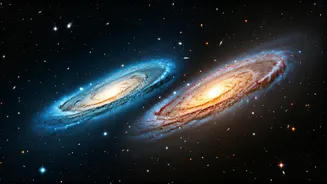

Galactic Harmony Unveiled
Recent observations have revealed a mesmerizing spectacle in the cosmos: galaxies moving in a coordinated fashion across an immense expanse of space, approximately
50 million light-years wide. This synchronized motion defies the expectation of random galactic movements and strongly suggests a deeper underlying order in the universe. Scientists studying these movements believe that the alignment and consistent flow are indicative of shared gravitational influences, large-scale structures, and possibly, the pervasive presence of dark matter. The discovery marks a significant step towards understanding the intricate processes that shape the architecture of the universe and galaxy behavior.
Unveiling Cosmic Threads
The coordinated movement of galaxies offers crucial insights into the formation and evolution of cosmic structures. The aligned motion suggests galaxies are not isolated entities, but rather, they are interconnected by a cosmic web of gravitational forces and vast, invisible structures. This interconnectedness allows for synchronized galactic dance, where the motions are influenced by the distribution of dark matter, a mysterious substance that makes up the majority of the universe's mass. This coordinated action helps to paint a picture of how galaxies gather into clusters and superclusters, revealing the large-scale structure of the cosmos.
Dark Matter's Role
Dark matter is considered to be a key element in this galactic choreography. Its influence is believed to be widespread across cosmic regions, shaping the gravitational landscapes in which galaxies reside. Although dark matter is not visible, its presence is inferred from its gravitational effects on visible matter, such as the observed motion of galaxies. The alignment and synchronized movements could be direct evidence of dark matter’s significant contribution to galactic evolution. Through further study of the synchronized galactic dance, scientists hope to gain new perspectives on dark matter’s distribution and role in the universe’s structure and dynamics.
Expanding Universe Questions
The discovery also deepens the ongoing discussion about the universe’s expansion rate. The aligned galactic motions suggest that the galaxies within this extensive region are affected by a consistent force, which may impact our models of cosmic expansion. Determining the precise relationship between galactic movement and expansion rates could lead to refinements in our understanding of the universe's past, present, and future. Researchers are keen on combining this observational data with other evidence, such as measurements from telescopes, to understand these cosmic structures and their expansion dynamics.
Future Research Pathways
The study of the synchronized galactic movements serves as a foundation for future exploration. Scientists aim to analyze more regions of the universe, seeking additional examples of galaxies exhibiting synchronized behaviors. This could offer insights into the prevalence of similar structures and their influence on the cosmos. Advances in observational technology, such as the upcoming James Webb Space Telescope, will potentially offer more detailed data, enabling scientists to observe these galaxies with unprecedented precision. The information gained will contribute to refining our cosmological models, with the goal of more accurately depicting the universe’s complex nature.