
Europa's Intriguing Surface
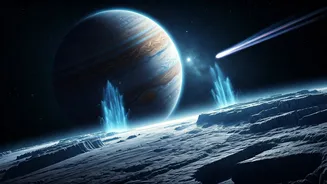
Europa, a celestial body orbiting Jupiter, has captivated the scientific community due to its unique characteristics. The moon is covered by a smooth,
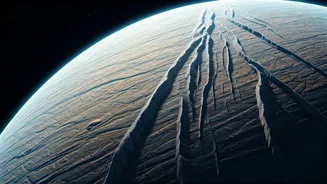
icy surface, riddled with cracks and ridges. Among these features is a distinct pattern referred to as the 'spider scar'. The spider scar is a remarkable structural form that has raised questions about the internal composition and geology of Europa. The surface ice shows signs of geologic activity, with fractures and plate-like sections that are perpetually moving and shifting. These formations have stimulated the intrigue among scientists, leading to investigations of Europa's depths to find answers and explanations.
The 'Spider Scar' Explained
The 'spider scar' on Europa appears as a network of intersecting lines that originate from a central point, hence the name. The structure is believed to be the consequence of a significant impact event or could be associated with subsurface geological processes. The scar is a network of ridges and fractures and holds clues about what lies beneath the surface. Scientists have been analyzing data from space-based observations, which offer detailed views of the structural network. The detailed analyses of these images, combined with other observations, help scientists piece together the history of Europa's surface.
Subsurface Ocean Hypothesis
The existence of a subsurface ocean on Europa is one of the most exciting propositions in the field of astrobiology. Scientists theorize that this ocean lies beneath the icy crust, potentially containing more saltwater than all the Earth's oceans combined. The idea is that this water could be in contact with a rocky mantle. The presence of water is fundamental to the hypothesis of the possibility of extraterrestrial life. This subsurface ocean could harbor hydrothermal vents that provide energy, forming an environment in which life can thrive. Exploring this water is a principal goal of missions to Europa, aiming to discover and analyze this unique environment.
Evidence of Salty Water
Recent findings have strengthened the hypothesis that the subsurface water is salty. Analyzing the composition of the icy crust and the geological formations has produced clues. Scientists believe that the complex features on the surface, including the 'spider scar', may be linked to the release of subsurface materials. Analyzing these materials provides a better view of the ocean below. The detection of salt compounds on the surface further solidifies the theory of a salty ocean. Such data assists in creating models of Europa's internal composition and geological activities, assisting researchers to explore the possibilities of life.
Implications for Life
The discovery of a potential ocean and the existence of a spider scar hold significant implications for the possibility of life on Europa. If the ocean exists and is linked to the mantle, there's a possibility of the existence of hydrothermal vents, similar to those found on Earth. These vents can provide energy that sustains life. Analyzing the composition of the ice and any possible geological formations offers insights into the moon's suitability for life. Exploring Europa is among the priority goals of space agencies worldwide, as it may provide valuable knowledge in the quest to identify and understand life beyond Earth. Understanding these features can shape our approach to search for life.
Future Missions and Study
The prospect of discovering life on Europa has initiated the design and launch of different space missions. The most notable mission is designed to analyze Europa’s surface, subsurface composition, and the potential existence of life. These missions are planned to use cutting-edge technologies to pierce the ice, and obtain and study samples from the subsurface ocean. The missions aim to identify any biosignatures and collect data about the ocean, including its composition and possible activities. The gathered information will provide an unmatched knowledge of the moon. The findings will assist scientists in understanding the potential habitability of Europa.