






Safety Standards Clash
Amazon's Prime Air, the company's ambitious drone delivery initiative, has publicly announced its departure from the Commercial Drone Alliance, a significant
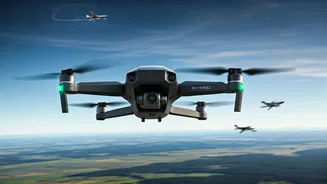
industry association. This decision stems from a profound disagreement regarding the implementation of safety protocols, particularly concerning the integration of drones into the national airspace alongside traditional aircraft. In a formal letter, Prime Air articulated that the alliance's stance on critical safety issues is fundamentally at odds with its own core principles. The dispute centers on the requirement for drones to possess sophisticated detect-and-avoid systems, designed to prevent mid-air collisions with crewed airplanes and helicopters. Prime Air emphasized its commitment to rigorous, capability-based standards, asserting that technologies capable of identifying and avoiding non-cooperative crewed aircraft are essential for safe operations.
Detect-and-Avoid Debate
The crux of the disagreement lies in the proposed Federal Aviation Administration (FAA) regulations that would mandate drones to be equipped with systems capable of detecting and avoiding aircraft that are not actively broadcasting their location. Prime Air highlights its own extensive operational history, including over 70,000 drone flights, during which its detect-and-avoid system successfully averted two potential mid-air collisions with crewed aircraft. These near misses, the company stresses, could have resulted in catastrophic outcomes, including loss of life. The Commercial Drone Alliance, however, opposes this prescriptive technological requirement. Instead, the alliance advocates for a performance-based framework, suggesting that aircraft operating below 500 feet should be required to broadcast their position using satellite-based technology or other electronic systems, allowing drones to ascertain their whereabouts.
Industry Reactions & Future
The Commercial Drone Alliance, whose members include notable companies like Skydio, Zipline, and Alphabet's Wing Aviation, expressed regret over Prime Air's withdrawal. The group reiterated its belief that a performance-based approach, rather than strict technological mandates, allows for safe operations while simultaneously encouraging innovation and competition. They pointed to their members' collective experience of millions of safe drone operations as evidence. Prime Air, however, maintains that the risk of drone collisions with crewed aircraft is a tangible concern, not merely a theoretical one. The company cited a recent incident where its system was crucial in avoiding a collision with a helicopter that was not broadcasting its position as required, a situation that without the drone's technology, would have been dire. The unresolved debate underscores the complex challenges in establishing safety regulations for the rapidly evolving drone industry.