







The Water Aversion
New scientific findings have unveiled a peculiar behavior in bed bugs (Cimex lectularius): a profound avoidance of water and damp surfaces. While these
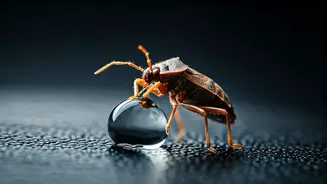
small, wingless parasites are notorious for their resilience and difficulty to eradicate once established in a home, this research highlights a previously unknown behavioral trait. The study, conducted at the University of California, Riverside, and published in the Journal of Ethology, suggests that moisture poses a significant deterrent to these blood-feeding insects. This discovery aligns with their physical characteristics, as their flat bodies and spiracles (small breathing openings) can become obstructed when in contact with water, posing a potentially fatal adhesion risk. This aversion to wetness is a key finding that could reshape our understanding and approach to managing bed bug populations.
Accidental Lab Discovery
This significant insight into bed bug behavior emerged quite by chance within a laboratory setting. Researchers were maintaining bed bug colonies in vials, using an artificial feeder filled with blood for sustenance. During one routine feeding, a slight malfunction caused the feeder's membrane to leak, allowing blood to seep onto the paper lining inside the vial. The expectation was that the bed bugs, drawn to the blood, would readily consume it from the saturated paper. However, the observation was contrary: the insects actively steered clear of the damp areas, even refusing to venture near them. This unexpected reaction prompted the scientists to investigate further, leading them to test if moisture itself, rather than the leaked blood, was the cause of this avoidance.
Experimenting with Moisture
To confirm their suspicions, the research team intentionally dampened the paper in the vials with plain water. The bed bugs exhibited the same pattern of avoidance, confirming that moisture was the critical factor. This observation spurred more rigorous investigation into their response to wet surfaces. A postdoctoral researcher in the lab, Jorge Bustamante, Jr., designed specific experiments to quantify this behavior. Given the small size of young bed bugs – often less than 2 millimeters long – specialized equipment was necessary. A high-powered infrared camera with a magnifying lens was employed to meticulously record the movements of these tiny insects as they encountered wet areas, allowing for precise tracking of their speed and distance traveled, and enabling researchers to analyze any differences in response based on the bugs' age or sex.
Universal Aversion and Control
The detailed experiments confirmed that bed bugs universally shy away from damp surfaces, regardless of their age or sex. Both younger and older insects demonstrated a similar pattern of retreat from wet zones, often turning away more rapidly than they approached. Notably, the very youngest and smallest bed bugs displayed an even more pronounced reaction, frequently executing sharp U-turns upon nearing moisture, suggesting a heightened sensitivity in immature stages. This discovery has significant implications for pest control. Many common insecticide treatments are applied as water-based sprays. The research indicates that if these sprays don't immediately eliminate the bed bugs, the insects might simply be driven away from the treated areas, potentially leading to dispersal and re-infestation elsewhere. This suggests a need to refine application methods to ensure effectiveness.
A Simple Personal Solution
Beyond its implications for professional pest control, the research offers a remarkably simple and immediate solution for individuals who suspect bed bugs might be on their person. According to lead researcher Dong-Hwan Choe, a straightforward action can effectively resolve such a situation: taking a bath. While this would address bed bugs directly on a person, Choe clarifies that it would not solve infestations within the broader environment, such as on beds or in rooms. Nevertheless, for direct contact, the aversion to water presents an accessible and practical countermeasure. This finding adds a novel layer to our understanding of bed bug behavior, providing both scientific insights and actionable advice for managing these persistent pests.