






Echoes from the Dawn
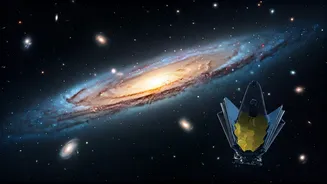
The James Webb Space Telescope (JWST) has captured breathtaking images of the cosmos from its earliest epochs, a time just a few hundred million years
after the Big Bang. A recent scientific inquiry focused on galaxies observed at a redshift of approximately 6 to 10, a period when the universe itself was remarkably young, between 500 and 800 million years old. Astonishingly, the analysis of 31 such galaxies indicates that they are nearly as ancient as the universe was at that juncture. Employing sophisticated modeling techniques, specifically the Bruzual and Charlot evolutionary synthesis models, astronomers were able to derive an average stellar age of about 600 million years for these nascent galaxies. This finding brings these distant stellar systems remarkably close in age to the universe itself during that formative era.
Cosmic Age Anomalies
The investigation into JWST data revealed an unexpected characteristic in several early galaxies: some appear to have formed and matured at an accelerated rate. When examining 31 galaxies located at redshifts between z≈6 and z≈10, a timeframe when the universe was approximately 500 to 800 million years old, researchers found their stellar populations to be significantly developed. The models used in this study diligently accounted for factors that could influence age estimations, such as the presence of interstellar dust and the activity of supermassive black holes at galactic centers. The derived average stellar age of these galaxies was estimated to be around 600 million years, a figure that nearly matches the age of the universe at that time. In a particularly striking observation, one specific galaxy, designated JADES-1050323 and located at z=6.9, presented an age estimate that surpasses the total age of the universe as currently understood. If this extraordinary finding is definitively confirmed, it would represent a profound challenge to the prevailing Lambda-CDM cosmological model. Furthermore, other independent research groups have also reported similar unusual patterns in early JWST galaxies, pointing to stellar populations that are unexpectedly mature for their cosmic age.
Rethinking Cosmology
These surprising discoveries regarding ancient galaxies are part of a growing pattern of unexpected results emerging from the study of the early universe with JWST. For instance, prior astronomical surveys have identified galaxies at distances corresponding to 12.5 billion light-years that already possess a rich abundance of heavy elements, such as carbon and oxygen. This chemical maturity is considerably more advanced than what standard cosmological models would predict for galaxies existing so early in cosmic history. Additionally, other studies have reported the existence of galaxies that are both massive and highly evolved, appearing just a few billion years after the Big Bang. The collective weight of these anomalies suggests that galaxy formation and evolution processes may have occurred at a much swifter pace than previously theorized. Should the age estimates for these early galaxies, as determined by the Webb telescope, withstand further scrutiny and verification, it could necessitate a substantial revision of the standard Lambda-CDM model that currently underpins our cosmological framework.