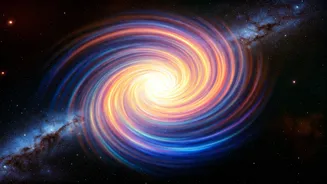

The Enigmatic Star
In the vast expanse of the cosmos, the death of a star doesn't always signal the end of the story. Sometimes, it initiates a new and peculiar chapter,
as demonstrated by the case of this dead star. Astronomers have identified a persistent shockwave surrounding this celestial remnant, a discovery that has puzzled the scientific community. This shockwave isn't a fleeting event, but a continuous phenomenon, defying expectations and conventional models of stellar behavior. The existence of this shockwave around a dead star presents a unique opportunity to probe the physics of stellar remnants and the environment they inhabit. The shockwave's persistence hints at a continuous energy source, leading researchers to examine the mechanisms powering it. Determining the origin of this shockwave is crucial for understanding the ultimate fate of stars and the remnants they leave behind. This could involve exploring the star's interactions with its surroundings, or the processes occurring within the remnant itself.
Shockwave's Unexpected Nature
The shockwave's consistent presence around the dead star is what truly sets it apart. Shockwaves are commonly observed in space, triggered by events such as supernova explosions or the powerful winds emitted by stars. However, in the case of this dead star, the shockwave's enduring nature is unexpected. It suggests a sustained process, continually injecting energy into the surrounding space. Normally, stellar remnants, like white dwarfs or neutron stars, are considered relatively stable objects that eventually fade over time. But the sustained activity suggests there's a continuous, unseen mechanism at play. Scientists now face the challenge of understanding the mechanics behind this continuous shockwave. This requires a deeper understanding of the interactions between the dead star, its surroundings, and the complex physics at work. Investigating the shockwave offers a unique chance to study extreme astrophysical environments, and to potentially uncover new physics governing matter and energy.
Unveiling the Mechanisms
To unravel the mystery of this persistent shockwave, astronomers and astrophysicists must employ a range of investigative tools and models. The process involves comprehensive observation, detailed analysis, and complex simulations. First and foremost, astronomers rely on telescopes and other observation platforms to study the shockwave's characteristics. This includes analyzing the wave's spectral properties to determine the composition, temperature, and density of the material involved. Moreover, researchers construct theoretical models to simulate the processes that could potentially generate the shockwave. These models take into account various parameters, like the star's magnetic field, its rotation, and the properties of the surrounding interstellar medium. Comparing observational data with the model predictions provides a means to test hypotheses and uncover the mechanisms that drive the shockwave. Researchers might also examine the interaction between the dead star and its surroundings, looking for evidence of material being expelled or interacting in some way. Particle acceleration and radiation processes may be considered to understand how energy is transported and transformed within and around the dead star.
Implications and Future Research
The discovery of a persistent shockwave around a dead star carries far-reaching implications, impacting our understanding of stellar evolution and particle physics. It challenges existing models, urging scientists to reconsider their understanding of the final stages of a star's life cycle. This unexpected phenomenon also sheds new light on the behavior of matter in extreme environments, where gravity and other forces reach incredible intensities. In terms of future research, astronomers will likely focus on gathering more detailed data on this shockwave. This can involve using advanced telescopes and observatories to get more precise measurements of the wave's properties and behavior. Moreover, scientists might collaborate to create more sophisticated computer simulations, improving their understanding of the underlying physics. These future studies may help scientists unravel the mystery of the shockwave, furthering our knowledge of the universe, and potentially lead to the discovery of entirely new celestial processes and behaviors. This research will also help refine our knowledge of the lives and deaths of stars.