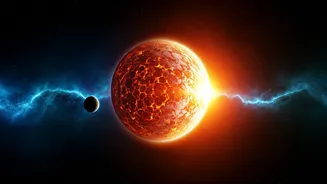

Stellar Evolution's Endgame
Stars, like our sun, undergo a life cycle that ultimately leads to their demise. As stars age, they begin to exhaust their nuclear fuel, resulting in dramatic
changes. The core contracts while the outer layers expand significantly. This expansion transforms the star into a red giant. This process is not immediate; it unfolds over millions or even billions of years, but the consequences are unavoidable for any planets in the star's vicinity. The expanded red giant phase brings about significant changes in the star's characteristics, including its size, temperature, and luminosity, which directly affect the planets in its orbit. The study of these aging stars provides critical insight into the potential fate of planets like Earth, offering a preview of what could await us in the distant future.
Red Giants' Expansion
During the red giant phase, a star's size swells dramatically, often consuming inner planets or profoundly altering the atmospheres and surfaces of those that remain. This expansion is driven by the depletion of hydrogen in the core, causing the core to contract and the outer layers to expand significantly. The increase in size also leads to a decrease in the surface temperature, making the star appear redder. The red giant phase is characterized by intense stellar winds and the ejection of stellar material, which could strip away the atmospheres of nearby planets and alter their orbits. This period represents a critical point in a star's life cycle, a prelude to its ultimate fate. The observations of red giants reveal that planets can either be engulfed or subjected to intense radiation and heat, making them uninhabitable.
Earth's Uncertain Future
Considering the evolution of our sun, Earth is likely to face a similar fate as the red giant phase commences. The sun's expansion will bring it closer to Earth's orbit, eventually consuming the planet entirely. Before its complete consumption, Earth will undergo dramatic transformations, with rising temperatures and altered atmospheric conditions. Before engulfment, the Earth is likely to face extreme heat and radiation, rendering it uninhabitable for life as we know it. The duration of this process and the exact impact depend on several factors, including the precise nature of the sun's expansion and its effect on Earth's orbit. Studying aging stars helps to better understand the range of possible scenarios and provides insight into the long-term prospects for our planet and the possibility of life in other planetary systems.
Observing Dying Stars
Astronomers use various methods to study aging stars, including telescopes and advanced imaging techniques. By observing these stars in different stages of their life cycle, scientists can gather data on their sizes, temperatures, and compositions. Studying the light from aging stars provides clues about the elements they are made of and how these elements change over time. By combining these observations with theoretical models, scientists can simulate the evolution of planetary systems and predict the impact of stars on their planets. These methods include examining the spectra of stars to identify the elements present, as well as observing the effects of stellar winds and the eventual fate of planets orbiting the stars. Advanced simulations help scientists construct detailed models that show stellar evolution and how it interacts with planets over vast timescales.
Cosmic Lessons Learned
The study of aging stars and their interaction with planets provides valuable insights into the broader context of cosmic evolution and the search for habitable worlds. It serves to understand the long-term viability of life in the universe and the factors that influence the habitability of planets. These observations challenge existing concepts and provide a clearer picture of cosmic events and planet formation. The data gathered provides a deeper understanding of the processes governing the formation, evolution, and eventual fate of planetary systems, improving our comprehension of the conditions necessary for life in the universe. Such information also helps in defining the potential for life's existence across the universe, improving our knowledge of planetary systems and cosmic processes.