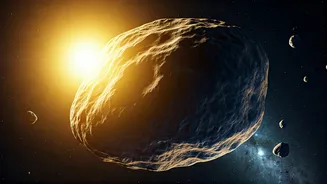

Rocky Space Travelers
Asteroids, often described as space rocks, are essentially remnants from the solar system's genesis, dating back approximately 4.6 billion years. These
space bodies are primarily located in the asteroid belt, situated between Mars and Jupiter, a region that is home to millions of asteroids of varying sizes. Their composition varies significantly, including metals like nickel and iron, as well as rocky materials. These asteroids range in size, from small particles to large celestial bodies hundreds of kilometers in diameter, each offering unique insights into the formation of our solar system. The study of asteroids provides essential clues to understanding the composition and evolution of the solar system.
Diverse Compositions Observed
Asteroids are not uniform in composition; they display a remarkable diversity based on their formation and location within the solar system. Their mineral composition ranges from metallic (nickel-iron) to rocky (silicates). There are three primary classifications: C-type (carbonaceous), S-type (siliceous), and M-type (metallic). C-type asteroids, which are the most common, contain a significant amount of carbon and are dark in color. S-type asteroids are composed of silicate materials and metals, making them brighter. M-type asteroids, are rich in metals, particularly nickel and iron, which makes them quite reflective. These compositional variations reflect conditions during the formation of the solar system, making each asteroid type a unique snapshot of cosmic history.
Asteroid Belt's Secrets
The asteroid belt, situated between the orbits of Mars and Jupiter, is not a solid mass but a region containing millions of asteroids. This belt is an area where a planet could not form because of Jupiter's gravitational influence, which disrupted the accretion process. The total mass of the asteroid belt is significantly less than that of the Moon. This sparse distribution has allowed spacecraft, such as the Dawn spacecraft, to navigate through the belt safely. The asteroids within this belt vary significantly in size, ranging from small particles to large objects like Ceres, which is classified as a dwarf planet. The asteroid belt is a valuable source of information about the early solar system, offering clues about planet formation.
Near-Earth Asteroids
Near-Earth asteroids (NEAs) are a group of asteroids whose orbits bring them close to Earth. These asteroids are of great interest to scientists because of the potential threat they pose, as well as their accessibility for space missions. The most famous NEAs have orbits that intersect Earth's orbit, which can lead to close encounters. The NEAs are divided into three main groups: Atiras, Atens, and Apollos, based on their orbital characteristics. Space agencies actively monitor these objects using telescopes and sophisticated tracking systems to predict their trajectories. Such monitoring is crucial for identifying potential impact risks and planning mitigation strategies, if necessary. The study of NEAs also offers opportunities for resource exploration, as some asteroids contain valuable materials.
Asteroids & Planet Formation
Asteroids are crucial for understanding planet formation within the solar system. These celestial bodies are essentially leftovers from the early solar system's formation, a period that started roughly 4.6 billion years ago. They contain preserved materials that provide clues to the conditions and processes of that period. Scientists study the composition, size distribution, and orbital characteristics of asteroids to reconstruct the planetary formation process. Their compositions also provide insights into the raw materials available at that time, and the different types of asteroids reveal varying conditions within the early solar system. By studying asteroids, scientists gain insight into how planets like Earth formed and evolved over time, using them as time capsules.
Impact Events Explored
The impact of asteroids with planets, particularly Earth, has had a profound impact on geological and biological evolution. Throughout the Earth's history, numerous asteroid impacts have led to major extinction events and significant geological changes. The most famous example is the asteroid impact that led to the extinction of the dinosaurs. These events create impact craters, which provide evidence of past collisions. Studying impact craters allows scientists to understand the frequency and severity of past impacts. Current research aims to understand the long-term effects of asteroid impacts on the Earth's environment, climate, and the evolution of life. Furthermore, monitoring and understanding the risk of future impacts is a critical task for planetary defense.
Space Missions to Asteroids
Over the past few decades, numerous space missions have been dedicated to exploring asteroids. These missions aim to study their composition, structure, and origin, providing invaluable insights into the solar system. The Dawn mission, for example, studied the asteroid Vesta and the dwarf planet Ceres. The OSIRIS-REx mission successfully collected a sample from asteroid Bennu for return to Earth. These missions offer close-up views, allowing scientists to analyze surface features, collect data, and gather samples. Space agencies continue to plan future missions with advanced technologies to explore asteroids, furthering our understanding of the formation of our solar system, with a focus on resource identification, potential impacts, and planetary defense strategies. This research is driving innovation in space exploration.
Asteroids' Potential Resources
Asteroids hold a great potential for resource extraction, offering vast amounts of valuable materials, including water, metals (like platinum and iron), and other minerals. Water ice, in particular, found in some asteroids, could be a crucial resource for future space missions, serving as a source of drinking water, breathable air, and rocket fuel. Mining asteroids could provide resources that are scarce or expensive to obtain on Earth. Private companies and space agencies are increasingly investing in asteroid mining technologies and strategies, which involves developing techniques for identifying, extracting, and processing resources. This process would require advanced robotics, efficient mining techniques, and robust transportation systems. Asteroid mining could reshape space exploration and resource management.
Asteroids and Planetary Defense
Planetary defense is a crucial field that addresses the threat of asteroid impacts on Earth. Asteroid impact events can cause significant damage and even lead to extinction events. The main goal of planetary defense is to detect, track, and potentially deflect asteroids that pose a risk. Scientists utilize sophisticated telescopes and radar systems to identify and monitor near-Earth objects. If a threatening asteroid is detected, various mitigation strategies can be employed, including kinetic impactors (smashing a spacecraft into the asteroid to change its trajectory) and nuclear explosions (a more complex option). International cooperation and continuous research are essential for developing and implementing effective planetary defense strategies to safeguard our planet. Regular exercises and simulations help in preparing for a potential asteroid impact.
Unanswered Questions Remain
Despite significant progress in asteroid research, numerous questions still remain about these space rocks. Scientists are still working to fully understand the origins of different asteroid types and how they formed within the early solar system. There are mysteries about the composition of asteroids, especially regarding the presence of organic molecules and water ice in some cases. More research is needed to refine our understanding of asteroid impact risks and the potential long-term effects on Earth. Further studies also need to be undertaken to develop more effective methods for asteroid deflection and resource extraction. Continued exploration and data analysis will be key to unlocking these mysteries.