

AI Enhances Planet Hunting
Astronomers at the University of Warwick have leveraged a sophisticated artificial intelligence system, named RAVEN, to scrutinize extensive data collected
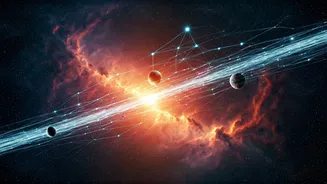
by NASA's Transiting Exoplanet Survey Satellite (TESS). This groundbreaking approach has led to the confirmation of more than 100 exoplanets, with an impressive 31 of these being entirely new discoveries. The TESS mission operates by detecting minute reductions in a star's brightness, indicating a planet passing in front of it. The RAVEN pipeline meticulously analyzed observations from over 2.2 million stars captured during the initial four years of TESS's operation. The primary focus of this AI-driven investigation was on planets with exceptionally short orbital periods, meaning they complete a full revolution around their host stars in less than 16 days. This focus helps researchers better comprehend the prevalence and characteristics of such closely orbiting celestial bodies, contributing significantly to our understanding of planetary formation and diversity across the galaxy. The validated planets include notable categories such as ultra-short-period planets, those residing in the rare 'Neptunian desert,' and multi-planet systems with tightly packed orbits.
RAVEN's Analytical Power
The identification and confirmation of exoplanets from the torrent of data generated by modern astronomical surveys present a significant challenge. Many detected signals can be misleading, often caused by phenomena like eclipsing binary stars, where two stars orbit each other and periodically block each other's light. The RAVEN system was engineered to tackle this precisely. Its robustness stems from a meticulously curated training dataset, comprising hundreds of thousands of simulated planets and astrophysical events that mimic planetary transit signals. This extensive training enables its machine learning models to discern intricate patterns within the observational data, accurately differentiating between genuine planetary transits and false alarms. Furthermore, RAVEN is designed as an end-to-end solution, capable of detecting signals, vetting them using its AI capabilities, and statistically validating them. This integrated approach distinguishes RAVEN from other tools, which typically address only specific stages of the exoplanet discovery workflow, offering a more comprehensive and efficient analysis.
Mapping Planetary Demographics
With the creation of such a large and rigorously characterized dataset, the research team has moved beyond individual planet discoveries to investigate broader trends in exoplanet populations. A complementary study, also published in MNRAS, utilized this data to precisely measure the frequency of close-orbiting planets around Sun-like stars, detailing these occurrences based on orbital period and planet size with remarkable detail. The findings indicate that approximately 9 to 10 percent of Sun-like stars host at least one planet in a close orbit. This figure aligns with prior estimates from missions like NASA's Kepler, but RAVEN's analysis significantly reduces the uncertainty, improving upon previous figures by as much as a factor of ten. The research also offers the first direct measurement quantifying the scarcity of 'Neptunian desert' planets, revealing they are found around a mere 0.08 percent of Sun-like stars. These precise quantitative insights demonstrate TESS's growing capability, now comparable to, and in certain aspects surpassing, Kepler's efficacy in the study of exoplanet populations.
Foundation for Future Exploration
The synergy between large-scale astronomical data processing and advanced artificial intelligence is proving to be a powerful engine for scientific discovery. This integrated approach not only facilitates the identification of novel exoplanets but also bolsters the reliability of these findings and deepens our understanding of planetary system architectures. The research team has generously made their findings accessible by releasing interactive tools and comprehensive catalogs. These resources empower other scientists to delve into the discovered exoplanets, identify particularly intriguing systems, and select prime candidates for further investigation using powerful ground-based telescopes and upcoming space missions, such as ESA's PLATO. This collaborative spirit ensures that the momentum of discovery continues, pushing the boundaries of our knowledge about worlds beyond our solar system.