






The Fiery Descent
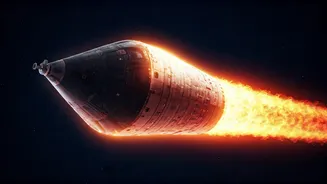
As the Artemis II mission concludes its lunar journey, the crew braces for what is arguably the most dangerous phase: atmospheric re-entry. The Orion spacecraft
is set to plunge back towards Earth, encountering extreme conditions as it decelerates from interstellar speeds. This descent is colloquially described as 'riding a fireball,' a testament to the immense heat generated by friction with the atmosphere. The spacecraft is projected to hit a peak velocity of 38,366 km/h before it begins its atmospheric interface. This immense speed translates into a staggering 25,000 mph as Orion cuts through the air, subjecting its outer shell to temperatures soaring to approximately 5,000 degrees Fahrenheit, a level comparable to half the surface temperature of the sun. The survival of the four astronauts aboard hinges entirely on the integrity and performance of the Orion capsule's advanced heat shield, a vital component designed to withstand these punishing forces and protect the crew from the inferno of re-entry.
Heat Shield Vigilance
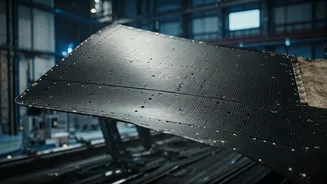
The effectiveness of Orion's heat shield is under intense scrutiny, especially following observations made during the uncrewed Artemis I mission in 2022. During that mission's return, the heat shield exhibited over 100 cracks and abrasions, with photographic evidence revealing distinct pockmarks where fragments of the protective material had seemingly detached. A NASA assessment from 2024 indicated that this 'unexpected behavior of the shield material creates a risk that the heat shield may not sufficiently protect the capsule’s systems and crew from the extreme heat of reentry on future missions.' Further investigation by NASA pinpointed the issue to the application of Avcoat, the shield's protective substance. It was found that the material had been applied too densely, hindering the escape of superheated gases and consequently leading to the observed cracking. Lockheed Martin, the capsule's manufacturer, subsequently revised the Avcoat application process for Artemis II, and NASA granted the spacecraft approval for flight, asserting that cabin temperatures would have remained safe for astronauts even with the damage sustained during Artemis I.
Design Adjustments and Historical Context
To address the issues encountered during Artemis I, Lockheed Martin implemented specific modifications to the Avcoat application for the Artemis II mission. As explained by Blaine Brown, a Lockheed Martin systems director involved in the Orion capsule's construction, the density was 'slightly modified to allow gases in the [Avcoat] to escape during high heating and cool down.' This adjustment aims to facilitate a more controlled dissipation of heat. Lockheed Martin expressed full support for NASA's decision to proceed with Artemis II, affirming their commitment to the mission's success and the safe return of the crew. It's worth noting that Avcoat has a history of use in NASA's space program, having been employed on Apollo missions. However, the application methods differed significantly: Apollo heat shields featured hand-applied Avcoat onto a honeycomb framework, whereas Artemis heat shields are constructed from approximately 200 pre-formed Avcoat blocks. Despite NASA's current confidence in the revised design, the Artemis II re-entry will serve as the inaugural comprehensive test of this updated heat shield during a crewed flight. The concerns surrounding heat shield performance inevitably evoke memories of the 2003 Columbia disaster, where a re-entry accident, triggered by heat shield damage sustained during launch, resulted in the loss of all seven astronauts. Columbia remains the sole crewed spacecraft lost due to re-entry heat, although the 1967 Soyuz 1 incident, which claimed the life of cosmonaut Vladimir Komarov, was attributed to a parachute deployment failure caused by electrical malfunction.
Recovery Operations Underway
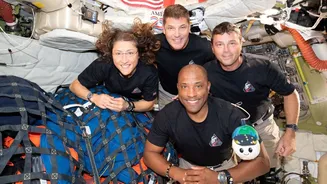
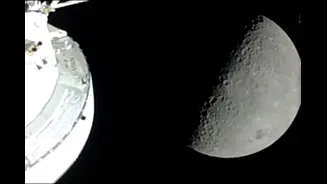
Despite the inherent risks, NASA officials have indicated that the Orion capsule is in excellent condition for its upcoming re-entry, with favorable weather predictions for the landing zone. Nevertheless, the agency emphasizes that this final phase of the mission represents one of its most critical junctures. Lakiesha Hawkins, acting deputy associate administrator for NASA's Exploration Systems Development Mission Directorate, stated, 'We're down to the wire now,' underscoring the significant remaining risk in safely bringing the crew back home. Preparations for the recovery are well underway, with the USS John P Murtha having departed port and en route to the designated splashdown area in the Pacific Ocean. Personnel from NASA and the U.S. military aboard the vessel are poised to assist with the recovery operations. Liliana Villarreal, Artemis II landing and recovery director, outlined the post-splashdown procedure: divers will open the Orion hatch, and astronauts will be assisted from their seats onto an inflatable raft, referred to as the 'front porch.' Subsequently, two Navy helicopters will shuttle the four astronauts to the recovery ship in quick succession. Upon boarding, the astronauts will undergo standard medical evaluations. As teams prepare for the landing, the crew has been reflecting on their historic journey, with mission specialist Victor Glover noting that he has been anticipating splashdown since being assigned to the mission in April 2023. Commander Reid Wiseman shared a profound experience of witnessing Earth eclipsed by the moon, describing it as an 'unbelievable sight.'