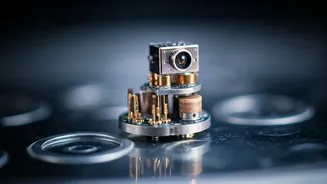








Microscopic Marvels Unveiled
The creation of sub-millimeter robots, tiny machines smaller than a millimeter, represents a significant leap in technological advancement. These minuscule
devices are engineered to function autonomously, meaning they possess the ability to perceive their surroundings, process information, and make decisions without requiring external guidance. Their design enables them to move and interact with their environments, executing tasks on a small scale. These robots integrate sensors, processors, and actuators, empowering them to perform a variety of operations in confined spaces or complex environments where larger robots might be impractical or incapable. This technology holds immense promise for applications spanning across multiple domains.
Autonomy and Intelligence
At the core of these innovative robots lies their ability to function autonomously. This means they are not simply remote-controlled; instead, they are equipped with sophisticated systems allowing them to make independent decisions based on sensory input. These micro-machines integrate advanced algorithms and artificial intelligence techniques that give them the capacity to analyze data from their sensors. The robots' internal logic enables them to interpret their environments and react accordingly, completing tasks in an intelligent manner. This autonomy is crucial for their performance, because it permits them to navigate, adapt to changes, and function effectively in environments beyond the scope of remote control.
Sensing and Action
These microrobots have sophisticated sensing capabilities, allowing them to gather information about their surroundings. Equipped with microscopic sensors, they can detect a broad range of environmental factors, including light, temperature, pressure, and chemical substances. The data gathered by these sensors is processed by the robots' onboard processors. This processing is essential for the interpretation of the surroundings and to trigger appropriate actions. The robots also come with actuators, which are essentially the 'muscles' that help them to act on their environment. Actuators enable these machines to move, manipulate objects, and perform specific tasks with precision. The coordination of sensing, processing, and actuation constitutes the foundational functionality, facilitating a wide array of capabilities.
Broad Application Potential
The implications of sub-millimeter robots are vast and span multiple industries. In the medical field, these tiny devices could revolutionize diagnostics and treatments. Their small size makes them ideal for targeted drug delivery, allowing medicine to reach specific sites with remarkable accuracy, thereby minimizing side effects. They could also be used for minimally invasive surgery, providing doctors with enhanced precision and control in delicate procedures. Beyond medicine, these robots hold great promise in manufacturing, allowing for the assembly of extremely intricate products, and in environmental monitoring, permitting the detection of pollutants or the assessment of damage in complex systems. Their versatility and tiny form factors open novel frontiers in various sectors.
Future Developments and Challenges
As this technology evolves, challenges and future developments are inevitable. A key area of focus is enhancing the robots' energy efficiency and extending their operational lifetimes. Developing dependable and miniaturized power sources is essential for sustained operation. Furthermore, there's a need to improve communication and coordination between multiple robots, enabling them to work together on intricate tasks. Miniaturization itself presents challenges in the design and fabrication, requiring advanced manufacturing techniques and materials. Overcoming these hurdles will be crucial for fully realizing the potential of sub-millimeter robots. Continuous research and development is sure to unlock additional capabilities and expand applications for these micro-machines.