







Unraveling the Mystery
The enigma of water on Mars has intrigued scientists for ages, sparking numerous investigations into the planet's geological past and possible signs of life.
Prior to these recent studies, scientists held various hypotheses about the presence of water, ranging from the existence of subsurface oceans to trace amounts in the atmosphere. The challenge lay in observing and confirming the specifics of water's form and distribution. Conventional methods encountered difficulties due to the Martian environment's harsh conditions, including its thin atmosphere and extreme temperature fluctuations. The main hurdles included detecting small quantities of water and differentiating between water ice, hydrated minerals, and other materials that might exhibit comparable spectral signatures. Despite these difficulties, researchers were determined to find an answer, leading to the breakthrough.
The Ice Layer Revealed
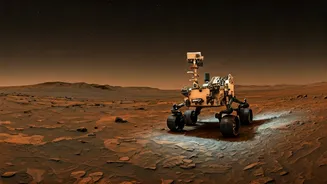
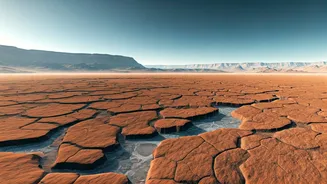
Groundbreaking research has unveiled a novel perspective regarding the water dynamics on Mars, identifying a thin layer of ice on the Martian surface. This layer is not widespread, but it exists in specific locations and under particular circumstances. Researchers utilized sophisticated analytical techniques to analyze data collected by orbiting spacecraft and surface rovers, revealing the ice's presence. These approaches combined spectral analysis, which detected the unique signatures of water ice, with high-resolution imagery to pinpoint areas where the ice was present. The discovery contradicted earlier models, which typically suggested that the water existed in different forms or that any ice would have been more deeply buried within the planet's regolith. The newly discovered ice layer is exceptionally thin, making its detection an impressive feat, and its distribution suggests a more complex interaction with Mars' atmospheric conditions and surface composition.
Formation and Conditions
The formation and continued existence of this thin ice layer are directly related to the unique environment of Mars. The planet's atmospheric pressure and temperature play critical roles, permitting ice to exist directly on the surface in specific regions. The ice forms through various processes, including the deposition of water vapor from the atmosphere and condensation during colder periods. Protective factors, such as the composition of the soil and the presence of dust or other fine particles, help stabilize the ice layer. These elements shield the ice from immediate sublimation into the Martian atmosphere. The planet's axial tilt, which causes significant variations in solar radiation across the surface, also affects the ice's presence. Some areas may experience prolonged periods of extreme cold, which favor ice accumulation, whereas others may see sublimation due to heightened solar exposure.
Implications and Future
This discovery has significant implications for our understanding of Mars and future explorations. The presence of surface ice, even in a thin layer, provides potential resources for future Martian explorers, specifically offering a source of water for sustenance, propellant, and other applications. Furthermore, the existence of ice raises questions about the possible existence of past or present microbial life on Mars. Water is essential for all known life forms, and the distribution and accessibility of water ice could influence the areas where life might have survived. Future research will likely concentrate on thoroughly mapping the distribution and thickness of the ice layer. Detailed studies of the ice's chemical composition and its interaction with the Martian environment will provide additional insights into the planet's history. The findings will certainly affect the design and aims of upcoming Martian missions and exploration programs.