






The Regeneration Hurdle
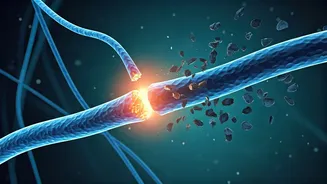
Nerve cells, or neurons, possess long extensions called axons that are vital for transmitting signals throughout our bodies. When these axons are damaged,
the body's ability to repair them is remarkably limited, especially in adult mammals. This deficiency often leads to persistent or permanent loss of sensory perception and motor control, prompting extensive research into why this regenerative capacity is so restricted. Researchers have now identified a key molecular mechanism that appears to be the culprit, acting as a significant impediment to the natural healing process of damaged neural pathways. Understanding this intricate process is a critical step toward developing effective therapeutic strategies for neurological injuries.
AHR: The Molecular Brake
A pivotal discovery has illuminated the role of the aryl hydrocarbon receptor (AHR) in nerve injury response. This protein functions as a molecular brake, directing neurons to focus on managing cellular stress rather than initiating the demanding process of axon regrowth. In essence, AHR acts as a switch, prioritizing immediate survival mechanisms over long-term repair. When researchers experimentally inhibited or removed AHR, they observed a remarkable improvement in the regeneration of damaged axons. This finding was consistently demonstrated in laboratory models, showing that disabling AHR's activity significantly enhances the potential for nerve fibers to regrow and reconnect.
Balancing Survival and Growth
Delving deeper into the mechanics, the study reveals that AHR plays a dual role. It aids neurons in maintaining protein quality control, a process known as proteostasis, which is crucial for cellular survival under duress. However, this protective function inadvertently limits the production of new proteins essential for axonal regeneration. Conversely, when AHR signaling is suppressed, neurons reallocate their resources. They ramp up protein synthesis and activate pathways that actively support axon growth. This delicate balance is further influenced by another factor, HIF-1α, which orchestrates genes involved in metabolic processes and tissue repair, underscoring the complex interplay of molecular signals in nerve healing.
Therapeutic Potential Unveiled
The implications of this research extend to potential therapeutic interventions. Notably, several existing drugs designed to block AHR are already undergoing clinical trials for unrelated conditions. This existing pipeline suggests a promising avenue for repurposing these medications to treat nerve and spinal cord injuries. While this presents an exciting prospect, further extensive research is imperative. Future studies will rigorously assess the efficacy of AHR inhibitors across various types of neural damage, determine optimal treatment durations and dosages, and investigate their broader impact on other cellular components following injury. The ultimate goal is to translate these findings into viable treatments that promote significant functional recovery.