
Distant Giants Examined
Uranus and Neptune, the outer planets of our solar system, have long been considered 'ice giants' due to their composition, primarily thought to be dominated
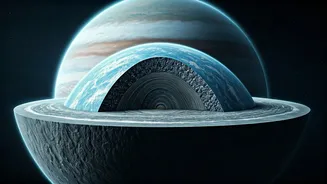
by water ice. However, recent models, developed with agnostic initial assumptions, propose a different scenario. These models suggest that these planets could contain a considerable amount of silicon dioxide rock. The presence of rock might challenge previous assumptions about their internal structures. The research explores the possibility that these planets, though appearing icy from the outside, might have a more complex and rocky interior. Images from the Hubble Space Telescope offer a visual representation of these planets, yet their internal structures remain largely unknown. These findings prompt further questions and investigations into the actual composition of these planets. This could reveal new information about how these celestial bodies formed and have evolved over time.
Rethinking Planetary Makeup
The research, based on models using “agnostic” initial assumptions, provides a fresh perspective on the composition of Uranus and Neptune. These models show that while water ice may be a major component, silicon dioxide rock could also be present in substantial amounts within the planets. The term 'agnostic' implies that the models did not start with preconceived notions about the planets' makeup. This approach allowed for a more unbiased exploration of different compositional possibilities. It allowed scientists to create a clearer understanding of what each of the planets could actually be made up of. This method of modeling challenges the current understanding and encourages further studies to accurately determine the proportion of rock and ice within these giant planets. The implications of this research are significant, as they could lead to a revised understanding of the formation and evolution of these outer planets. The scientists involved could further expand this type of modeling to other planets in the Solar System. The discovery could challenge the long-held beliefs about the composition of these planets and set the stage for future research.
Hubble's Observational Role
The Hubble Space Telescope has provided some amazing images of Uranus and Neptune, offering us a glimpse into these distant worlds. The images were taken in 2018 using the Wide Field Camera 3, providing crucial visual data. However, these images show only the exteriors of the planets, leaving the internal structures largely mysterious. The outer layers are what is observable with instruments like the Hubble, while the core and interior composition require more advanced investigation methods. This is why the modeling done by the scientists is so important. These observational findings highlight the need for further exploration and analysis to fully understand the internal structures of these planets. The research underscores the limitations of external observation techniques while highlighting the critical need for advanced modeling. This work emphasizes the need for advanced instruments, or even dedicated missions to these planets. This kind of research allows for scientists to get closer to the truth about how these planets were formed.
Future Research Pathways
The findings on Uranus and Neptune open up new avenues for future research. Scientists will need to conduct more research to verify the ratio of rock and ice in these planets. This could involve enhanced modeling and possibly new space missions equipped with advanced instrumentation. This includes potential missions to the ice moons of the solar system, which could provide valuable insights into the formation and composition of icy bodies. Additionally, researchers may begin searching for pristine comets, often referred to as 'cosmic time capsules'. These comets could hold clues about the early solar system and the building blocks of planets. Moreover, the study of these planets is greatly helped by technology. Recent advances in Earth-observation satellites, such as the European Space Agency’s ‘sounder’ satellite, could offer new data to support future studies. The integration of different research methodologies, including observational data and advanced modeling, is likely to be crucial for a complete understanding of Uranus and Neptune.