





A Cosmic Phenomenon
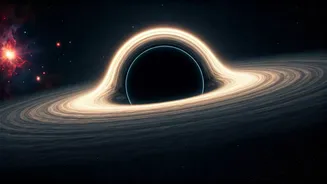
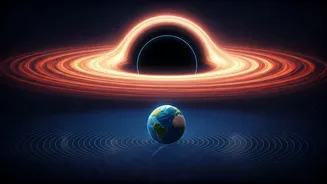
The remarkable observation of a black hole’s spacetime distortion marks a significant milestone in astrophysics. It confirms a prediction of Einstein's
theory of general relativity, that massive objects warp the fabric of spacetime around them. This observation adds to the mounting evidence supporting the principles of general relativity, and demonstrates the power of advanced astronomical instruments. The data comes from sophisticated techniques, using telescopes and analysis methods to detect the subtle effects of gravity near a black hole. This allows us to observe and measure how gravity interacts with light and other forms of energy around these cosmic entities. This direct confirmation of spacetime warping reinforces existing models and provides a more comprehensive view of how the universe functions on a grand scale.
Einstein's Prediction
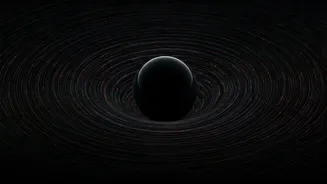
Albert Einstein's theory of general relativity, put forth over a century ago, proposed that gravity is not simply a force, but a manifestation of the curvature of spacetime caused by mass and energy. This idea implies that any object with mass or energy will warp the spacetime surrounding it, and other objects will move along those curves. Scientists have been trying to prove this concept with black holes. These are regions of spacetime where gravity is so intense that nothing, not even light, can escape. The presence of a black hole provides an extreme environment to test the theory, making it possible to observe strong gravitational effects. Measuring the effects of a black hole warping spacetime helps to validate the fundamental understanding of how the universe is structured.
The Observation Process
The recent observations relied on complex instrumentation and analysis. Scientists used advanced telescopes to gather data and analyzed the light emitted from the surroundings of a black hole. Because black holes do not emit light, scientists observed the behavior of light and matter orbiting the black hole. The techniques included measuring the shifts in the light's wavelength caused by the black hole's gravity, a phenomenon known as gravitational redshift. Analyzing the light's path and energy allowed scientists to map out the distortion of spacetime. The successful observation involved years of dedicated research, intricate data processing, and collaboration between numerous scientists from across the globe. The results of this study have been reviewed and validated by the scientific community to ensure their accuracy.
Implications and Future
The direct observation of spacetime distortion offers valuable insights into the nature of gravity. Confirming the predictions of general relativity in extreme conditions reinforces the robustness of our current model of the universe. This provides a detailed understanding of black holes and their impact on their surroundings. It provides an avenue for further exploration and research into the dynamics of black holes. Future research might focus on observing the spacetime distortions around other types of black holes, and use advanced tools to study these fascinating objects. The current study has opened new avenues for discovery. The observation is crucial for refining cosmological models and exploring some of the most complex phenomena in the universe, and the work done will pave the way for other discoveries in the field of astrophysics.