



Moon Homes Evolve
The dream of lunar habitation, once confined to science fiction, is rapidly becoming achievable thanks to groundbreaking advancements in habitat design.
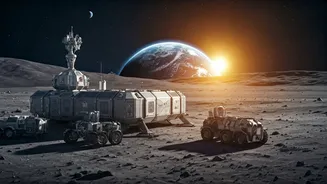
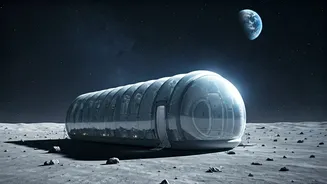
Scientists are now focusing on creating structures that are not only robust but also exceptionally light and easy to transport from Earth to the Moon. Among the most promising innovations are inflatable homes. These structures offer a revolutionary approach to space living, allowing for compact transport and easy deployment upon arrival. This method significantly reduces costs and addresses the harsh environmental conditions of the Moon, thereby accelerating our journey towards establishing a permanent human presence on our celestial neighbor. NASA's Bigelow Expandable Activity Module already demonstrates the effectiveness of such expandable structures, proving their viability for future missions and paving the way for advanced lunar living solutions that combine efficiency with safety.
Inflatables: The Solution
The primary hurdle in lunar exploration has always been the immense cost and complexity of launching heavy construction materials into space. Inflatable habitats elegantly sidestep this challenge by being exceptionally lightweight and compact during their journey to the Moon. The European Space Agency (ESA) has also recognized their potential, proposing concepts for lunar bases that incorporate both inflatable and 3D-printed designs, signaling strong industry confidence in their future applicability. Experts suggest that once deployed, these habitats can be further fortified by covering them with lunar regolith, or Moon dust. This additional layer provides crucial insulation and enhances protection against harmful cosmic radiation, significantly boosting the safety of astronauts. The ESA emphasizes that utilizing local resources, such as regolith, is fundamental to sustainable lunar living, reducing our dependence on costly resupply missions from Earth. Furthermore, the inherent expandability of these structures means that future lunar bases can grow and adapt over time, offering a scalable solution for long-term habitation plans.
Surviving Lunar Extremes
The scientific community is actively engaged in researching how humans can successfully adapt to the Moon's formidable environment, characterized by low gravity, intense radiation, and the absence of a substantial atmosphere. Studies and mission briefings, often supported by NASA's Human Exploration and Operations Mission Directorate, underscore the critical need for sustainable and reliable habitats. A key focus for experts is the development and integration of closed-loop life support systems. These systems are vital for ensuring the long-term survival and well-being of astronauts, particularly through efficient recycling of essential resources like air and water. Inflatable living spaces are seen as instrumental in enabling astronauts to undertake extended stays on the Moon, facilitating more comprehensive research and exploration. The success of these lunar habitats hinges on a multidisciplinary approach, seamlessly integrating advancements in engineering, biology, and environmental science. The Moon is not merely a destination but also a crucial testing ground, providing invaluable data and experience for future deep-space missions, including those to Mars and beyond.
Future Lunar Prospects
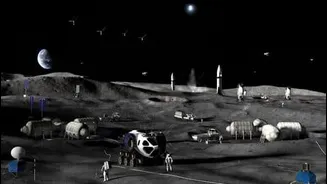
While the prospect of inflatable lunar homes is immensely exciting, several significant challenges remain to be addressed. Ensuring adequate protection against radiation, guaranteeing long-term structural integrity, and maintaining consistent internal pressure are critical areas of ongoing research and development. Nevertheless, the relentless progress in areas like Design Concept and Material Characterization provides strong evidence that lunar habitation is within reach. Innovative designs and pragmatic engineering solutions are transforming the idea of homes on the Moon from a distant aspiration into a tangible possibility, potentially enabling the establishment of the first human settlements. The evolution of inflatable homes on the Moon exemplifies the remarkable strides made in space science and technology, showcasing human ingenuity and adaptability. As space agencies and scientists continue their dedicated efforts, the Moon appears poised to become a much closer and more accessible frontier for humanity than we might have previously imagined.