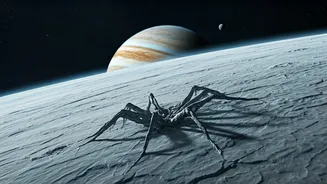

Europa's Spider Scar
Europa, a moon of Jupiter, continues to fascinate scientists with its potential for supporting life, and recent findings are boosting this hypothesis.
Researchers have identified a peculiar, spider-like formation on the moon's surface. The structure's unique characteristics and composition have prompted scientists to suggest its connection to potential subsurface water. This unusual scar is now a key area of study, offering exciting clues about the hidden environment below Europa's icy exterior. These surface features could act as indicators for underlying geological activity. The implication of a link to subsurface briny water means we have an even stronger chance of finding evidence of past or present life. The scar’s appearance, which resembles a spider, has further intensified scientific interest, prompting detailed analysis of its composition and the processes that formed it. This ongoing research promises to deliver valuable insights, changing our understanding of Europa's potential and making it a primary target in the search for extraterrestrial life.
Subsurface Briny Oceans
The presence of briny water beneath Europa's surface is considered crucial because water is a key requirement for life as we know it. The discovery of potential subsurface oceans has turned the spotlight on Europa, making it one of the most promising locations in the solar system for searching for life beyond Earth. The scar-like features could have formed due to the upwelling of salty water from the internal oceans. Scientists believe that this subsurface ocean, if it exists, could be in contact with Europa's rocky mantle, creating conditions that could support a habitable environment. The ongoing research focuses on confirming the composition, volume, and salinity of the water, as well as the mechanisms by which it interacts with the moon's surface. The study of Europa's subsurface oceans also helps understand the geological activity, and its connection to the surface features. The presence of water coupled with possible hydrothermal vents suggests that Europa could possess an environment with many elements that could be essential to life. The exploration of Europa continues, holding exciting prospects of discovering habitable conditions.
Implications for Life
If Europa indeed houses subsurface oceans, the likelihood of finding life significantly increases. The potential for liquid water on Europa, combined with a potential source of energy from tidal forces, creates an ideal environment for biological activity. The focus has turned towards searching for evidence of microbial life or biosignatures within these oceans. Scientists are using advanced instruments to analyze the composition of Europa's surface and the gases that might be emanating from the interior. These studies could point towards any present or past biological processes. The detection of any organic compounds or other signs of life would be of extreme significance. The Europa Clipper mission, set to launch in the near future, represents a critical step in this quest. It will conduct comprehensive surveys of Europa, aiming to confirm the presence of an ocean, analyze its composition, and search for evidence of habitability, bringing scientists closer to finding signs of life. The mission’s objective is to better understand this celestial body and its potential to harbor life beyond Earth.
Future Exploration Plans
The exploration of Europa is a significant objective for the scientific community, and many future missions are being planned to study the moon in greater detail. Missions, like the Europa Clipper, are specifically designed to analyze Europa's ocean. These missions will utilize advanced instruments to survey the moon's surface, atmosphere, and subsurface ocean. The missions will collect data about the composition of Europa and analyze its potential for harboring life. These planned explorations involve various technologies, including ice-penetrating radar, which will allow scientists to see through the moon's icy shell to the ocean below. The goal is to fully understand Europa's structure and activity. The ongoing exploration of Europa will continue to inform our understanding of the universe. The mission’s data and findings will also guide future exploration efforts, helping pave the way for human missions. Europa promises to hold answers about our place in the universe.